Local visual workbench

See the context before your AI uses it.

Holoself Workbench is an optional visual layer over the same local Markdown, project links, lenses, proposals, and connector contracts used by the CLI. It helps you inspect boundaries, take deliberate action, and keep durable learning behind human review.

Runs on 127.0.0.1· No hosted account· Markdown remains canonical· Optional interface
Start with orientation

Confirm the root and readiness first.

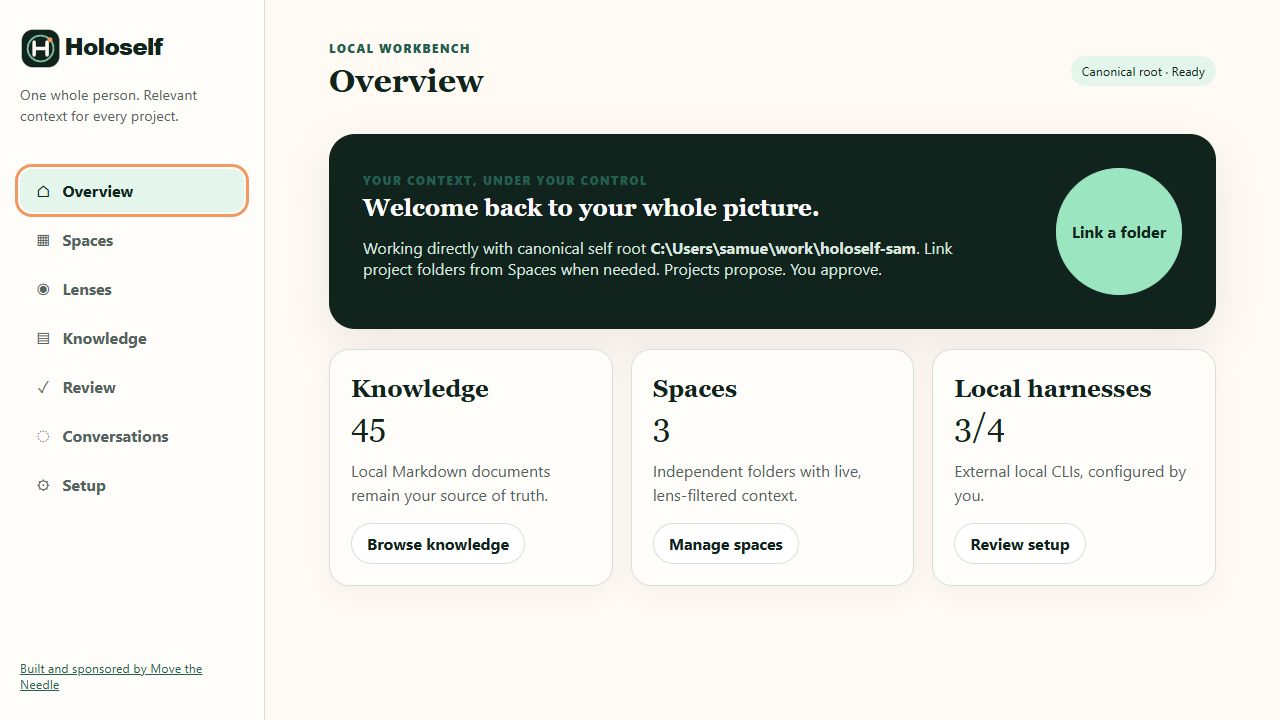
The Overview makes launch context visible before you link a folder, edit knowledge, or start a conversation. Counts are orientation signals; individual project spaces still carry their own health state.

Holoself Workbench Overview showing ready status, canonical root, knowledge count, linked spaces, and local harnesses
Confirm the intended canonical root, readiness, linked spaces, knowledge, and detected local harnesses before acting.
Spaces

Link projects without absorbing their work.

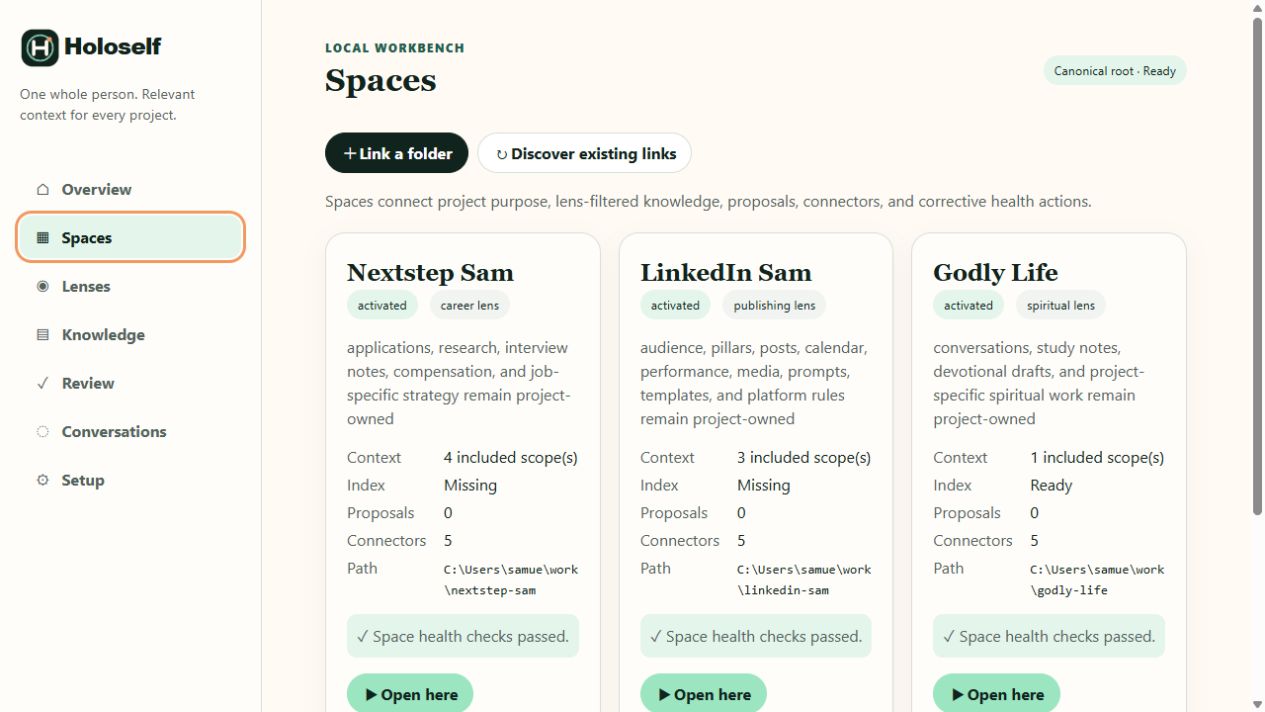
Each Space is an independent project folder. Workbench shows its lens, link health, rebuildable index state, proposals, and available local connectors while project artifacts remain in the project.

Holoself Workbench Spaces view showing activated project cards, lenses, health, indexes, proposals, and connectors
Link independent project folders, inspect health, and preview bounded context without copying canonical self.
Lenses

Choose what is relevant and permitted.

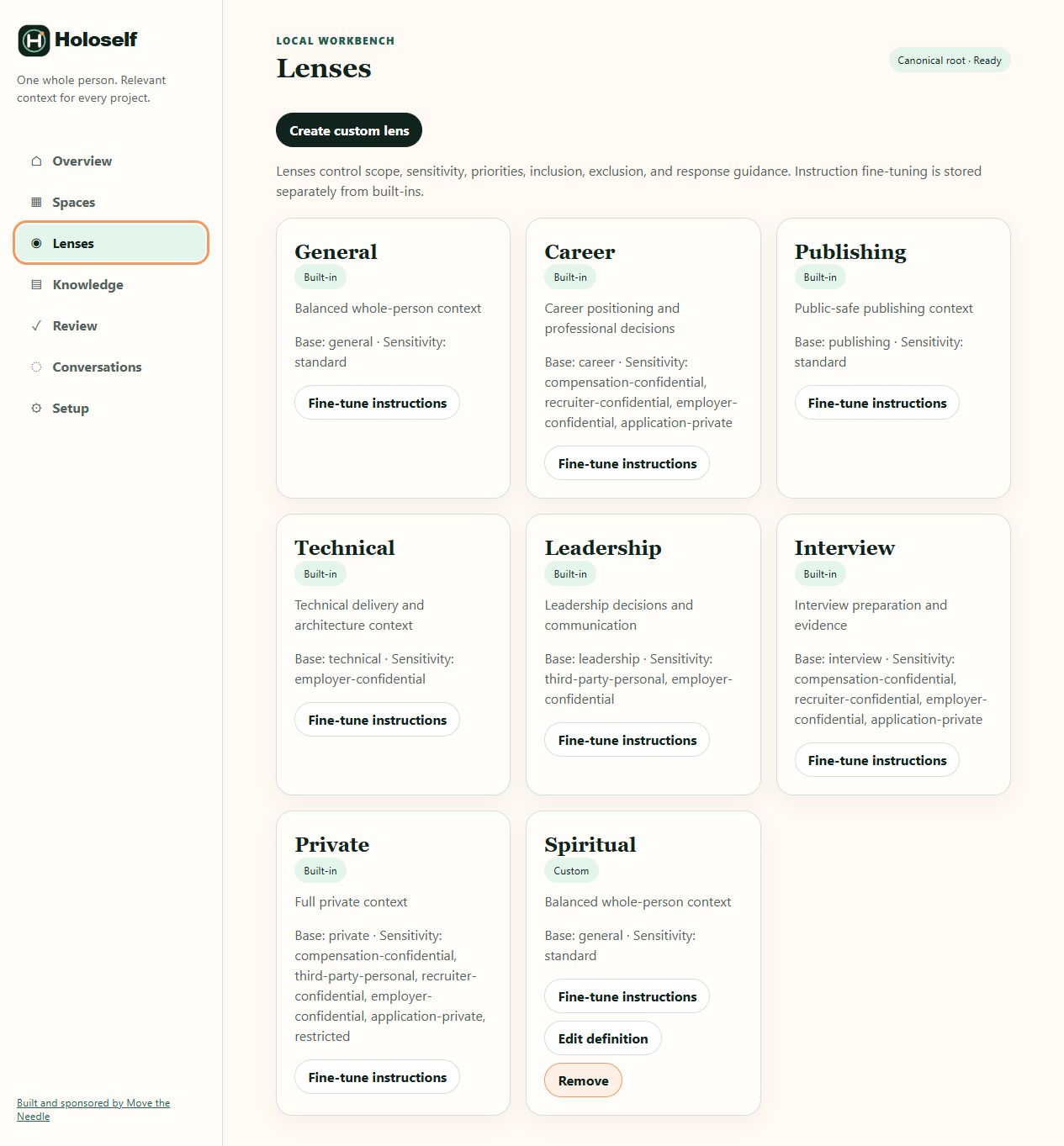
Built-in and custom lenses govern eligible context, sensitivity access, and response guidance. They narrow or deliberately extend selection; they do not turn restricted material into publish-approved content.

  • Start from the least-broad lens that fits the work.
  • Keep disclosure separate from simple file readability.
  • Preview resolved context after changing a lens.
Holoself Workbench Lenses view with built-in and custom lenses and their sensitivity access
Built-in and custom lenses make context and sensitivity boundaries inspectable.
Knowledge

Edit the readable source—with guardrails.

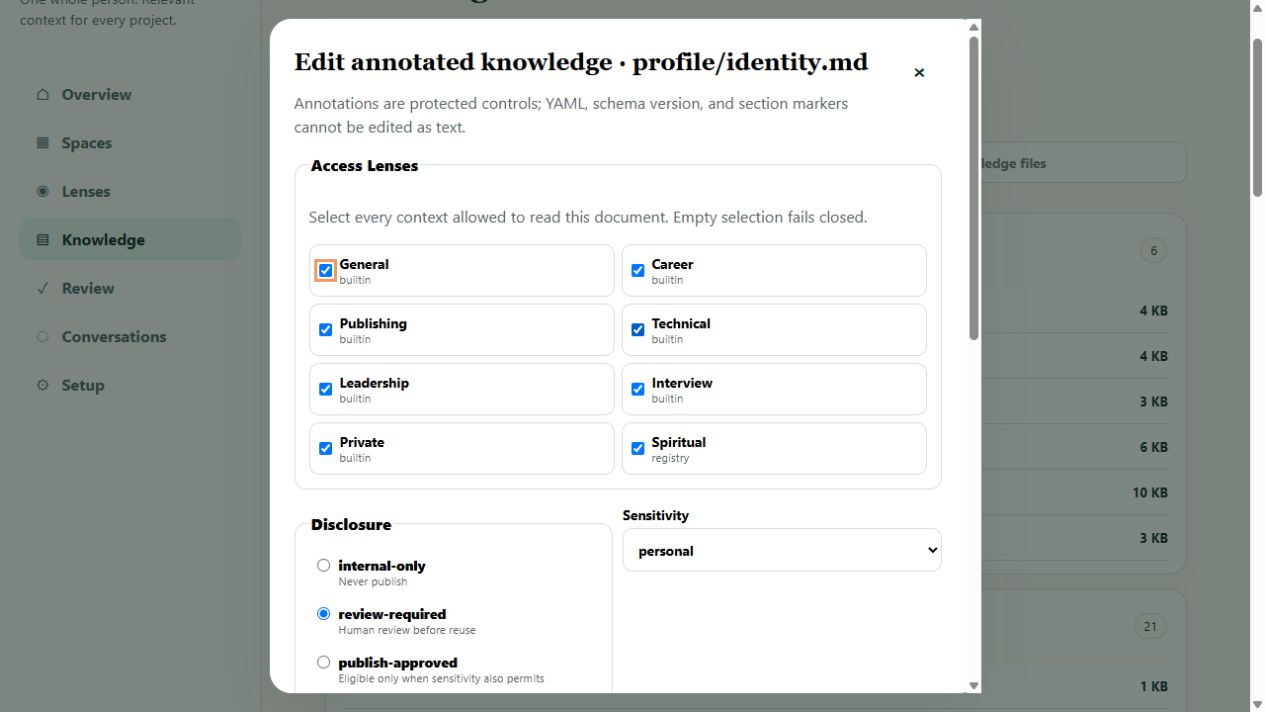
Workbench keeps Markdown as the source of truth. The guarded editor exposes content segments while protecting structural markers, checks concurrent changes, validates the root, and rolls back a failed save.

Holoself Workbench guarded knowledge editor with access lenses, disclosure, sensitivity, document role, and structured content controls
Access lenses, disclosure, sensitivity, and structured annotations stay explicit before validation.
Human approval boundary

Projects propose. You decide.

1 · Evidence

A project finds reusable knowledge

The proposal points to project-owned evidence and a canonical target.

2 · Review

You inspect the exact change

Target, source, structured changes, and current hashes stay visible.

3 · Decision

Approve, defer, reject, or supersede

Only an exact, current, approved change can update canonical self.

Self → Lens → Project → Proposal → Human approval
Conversations

Bring bounded context to a local AI tool.

Choose a healthy Space, an available local connector, and an appropriate lens. Each turn resolves current task-specific context and stores its transcript with the project—not in canonical self.
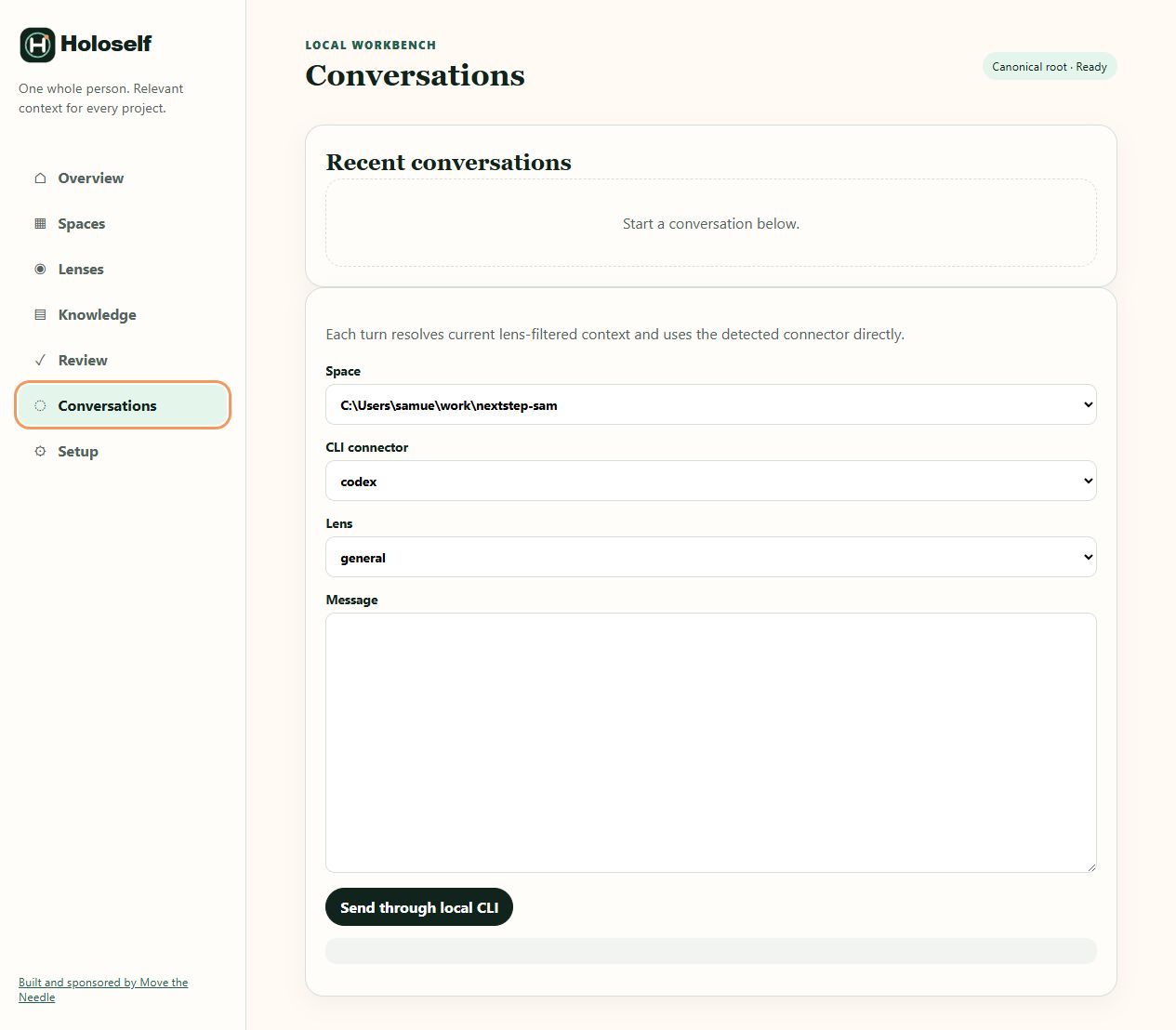
Holoself Workbench Conversations form with project Space, local connector, lens, and message selection
Run a context-aware turn through a detected local CLI; conversation transcripts remain project-owned.
Run it locally

The interface is optional. Your files are not.

Closing Workbench does not remove knowledge or project links. Launch it against the intended self root, then stop the local server with Ctrl+C.

holoself web --root C:/private/my-self

The screenshots show a real local canonical root captured on 1 September 2026. Counts, project names, paths, custom lenses, connector availability, and health states are machine-specific; document bodies and conversation output are not shown.