
Designed to Be Left Behind: Architectural Mobility in the Age of Disposable Models
When code generation is almost instant, unspecified boundaries become accidental monoliths in minutes. How pace layering, open records, deterministic verification, and three autonomy gates let an organisation replace its AI harness in an afternoon without losing its memory.
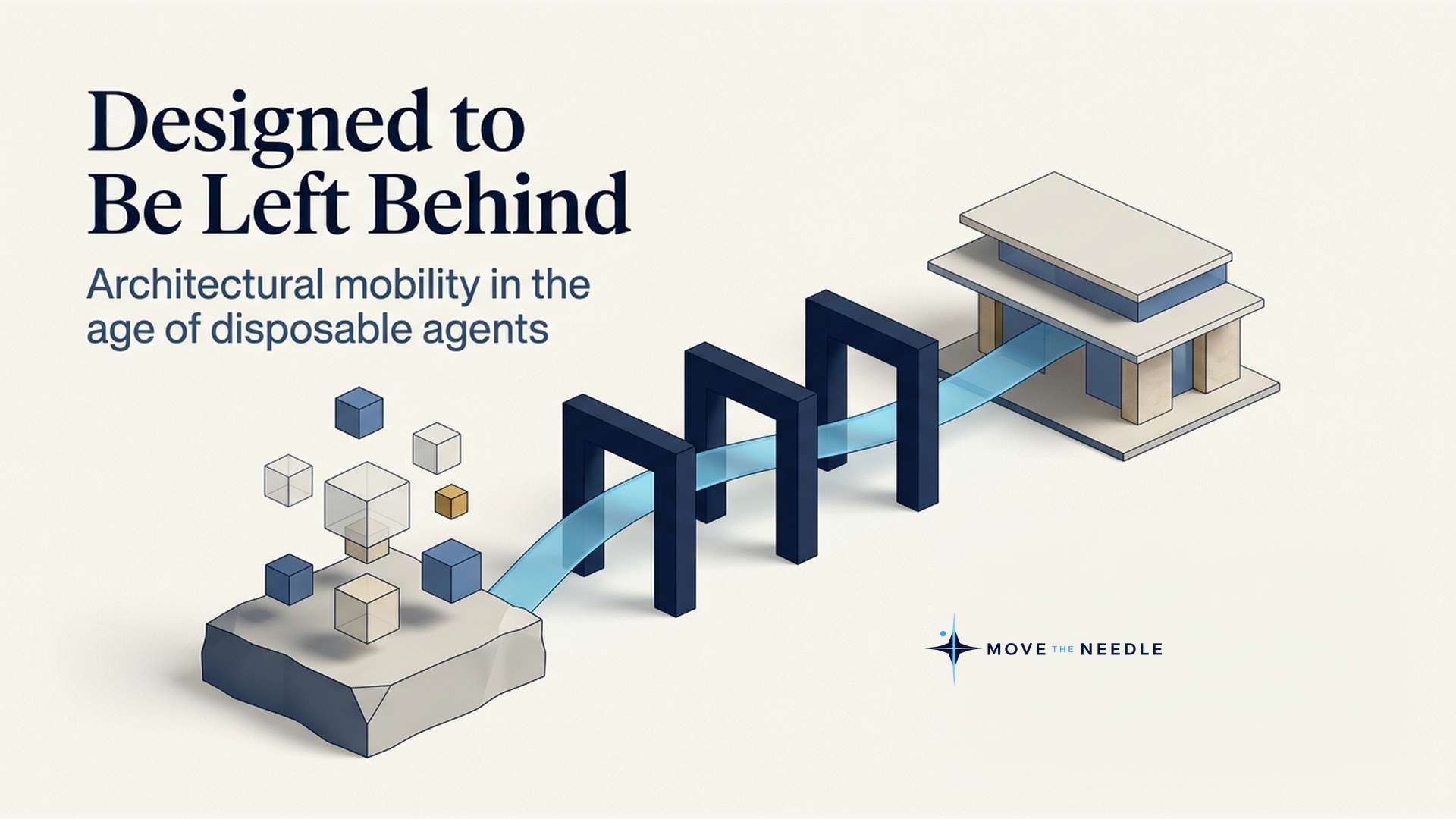
Could you choose to leave your current AI platform or application implementation behind? At what effort and cost? Why should you care about the implementation choices your team is making this week?
For executives and architects, these questions reach beyond the next procurement decision. How much of the organisation's memory, authority, and daily work already depends on a tool that felt easy to adopt?
I started with first-generation grok-bots. They were an easy, turnkey way to get my advisory practice running quickly, and they delivered real initial value. That convenience mattered. It gave me room to learn what the practice actually needed.
When I moved off that first harness, the software running the bots, the exit took an afternoon. I did not lose a single decision or client record. The transition was painless because the architecture had been designed to leave the tool behind from day one. The harness changed. The company's memory, decisions, and operating contracts stayed intact.
That experience left me with a question worth asking before the next implementation begins: are we making it easier to adopt a tool, while quietly making it harder to leave? The choices made this week determine how much freedom the organisation will retain later.
TLDR
- Architectural clarity cannot wait for the second release. Generated code fills missing boundaries immediately. Decide where state, authority, and verification belong before a convenient prototype becomes the operating model.
- Fast learns, slow remembers. Let models and harnesses change quickly. Keep institutional memory, governance, and business records on a slower, independently readable foundation.
- Buying and building form a continuum. Turnkey platforms buy speed and transfer operational work. Sovereign building buys control and creates engineering obligations. Make that exchange consciously.
- Put execution and evidence below the reasoning layer. Open records and deterministic checks make actions inspectable. A persuasive model response cannot substitute for an authorised transition or a passing verification.
- Continuous mobility creates strategic freedom. Replaceable components let you adopt capabilities, rebalance local and cloud workloads, and negotiate economics without surrendering accumulated memory.
- Channels are ephemeral wires. WhatsApp, voice, Slack, and web terminals carry requests. Durable records carry the business.
Why it matters: velocity, freedom, and executive agency
The relevant frontier extends beyond model intelligence. Runtimes, tool protocols, inference software, and local chips change the feasible combinations of capability, latency, privacy, and cost. An architecture that assumes one provider will remain optimal for every task gives away the ability to respond.
Freedom means choosing when to adopt those capabilities on your own priorities and economic terms. A business should be able to keep a reliable workflow unchanged while replacing the model behind it, or move a bounded extraction task onto local hardware without reconstructing its customer history.
The question is how much of the organisation must move whenever a supplier changes direction. Vendor churn becomes an executive problem when it reaches decisions, authority, and memory.
This changes how I interpret the familiar advice associated with Robert C. Martin's Clean Architecture: defer implementation decisions until you have enough information. His underlying case for independence from frameworks remains essential. Martin's architectural argument places business rules behind boundaries that protect them from external details.
When implementation was slow and expensive, delaying a tooling commitment preserved options. AI now produces substantial code almost immediately, although making it reliable still takes work. An unspecified boundary no longer stays empty for long. An LLM fills it with whatever integration makes the requested feature work.
Before you finish your coffee, session history can become customer memory, a prompt can become an approval policy, and a framework object can become the only representation of a business decision. The accidental monolith arrives through individually reasonable shortcuts.
The practical inversion is to decide the boundaries early so you can defer the tools safely. State ownership, authority, credential isolation, and proof requirements need explicit answers. The particular model, wrapper, and interface can remain provisional.
Two options, with a continuum between them
Option A: turnkey vendor platforms
Platforms such as Microsoft Copilot Studio and proprietary SaaS agent clouds offer a compelling bargain: rapid time to first demo, integrated interfaces, and less infrastructure to operate. For a bounded workflow inside an existing enterprise environment, that bargain may be entirely rational.
The possible taxes emerge over time. State may be difficult to inspect independently. Prompts and tool contracts can depend on platform-specific behaviour. Repeated context and tool loops can inflate token costs. Decision history may be exportable as messages but difficult to version as meaningful business records.
A provider's pricing change, product retirement, or framework discontinuation can then become your operational deadline. OpenAI's former Assistants API is a concrete lifecycle example: its migration documentation records its sunset on 26 August 2026. The lesson is to price lifecycle change into the architecture, rather than assume any interface is permanent.
These risks vary by product and configuration. A hosted service can provide strong export, audit, and governance capabilities. Those capabilities deserve to be tested before the organisation depends on them.
Option B: strategic sovereign building
At the other end, the organisation owns the durable records, operating contracts, and execution boundaries. Models and managed services plug into those contracts. Sovereignty here means control over the business assets and the ability to substitute suppliers, including cloud suppliers.
The returns are substantial: data custody, auditable history, compounding institutional memory, and freedom to route work across local and cloud resources. The ambition is near-zero state migration friction when replacing a cognitive component. Integration, evaluation, and operational testing still remain.
The investment is equally real. Someone must design and maintain schemas, backups, access controls, deterministic runners, and recovery paths. A workstation provides locality and simplicity while concentrating availability risk. An enterprise needs the same boundaries with infrastructure appropriate to its resilience and regulatory obligations.
Most useful designs sit between these endpoints. You might buy the interface and inference while keeping the work ledger and approval contracts under your control. You might accept tight coupling for a disposable experiment and require an exit rehearsal before production.
Neither option is inherently wrong. Discovering that the organisation surrendered its memory because the first demo was easy is a failure of executive ownership. Dependency should be an explicit economic decision, with an understood exit cost.
Five decisions that shape the operating system
These are the boundaries I chose for Move the Needle. Other contexts justify different implementations. The useful discipline is to make each choice explicit and understand what becomes easier or harder as the system grows.
1. State belongs in open records outside the agent session
Decisions, client records, operating rules, and editorial assets need representations that a person, a script, and a future model can read. Markdown works well for narrative records. Structured schemas preserve identifiers, relationships, and validation rules.
Transactional state also needs transactions. In mtn, the work ledger lives in SQLite on disk, with explicit schemas and readable projections. That distinction matters: Markdown is a useful document format, but it cannot replace atomic concurrency controls. Each record type needs one declared authority.
Vector search and relationship graphs can improve retrieval. They should be rebuildable from retained sources wherever possible. An embedding is an index of meaning, not a sufficient record of who decided what, on which evidence, under which authority.
Open formats also require operational discipline. Ownership, schema evolution, backups, and restore checks make records durable. A directory full of ungoverned files is another form of fragility.
2. Separate the pace layers: fast learns, slow remembers
Stewart Brand's pace-layering framework offers a useful design principle: “Fast learns, slow remembers.” Different parts of a system need different rates of change.
Models, prompt wrappers, and agent sessions occupy the fast layer. They experiment and propose. Canonical decisions, accounting, client commitments, and governance occupy the slow layer. They preserve continuity and constrain what experimentation may change.
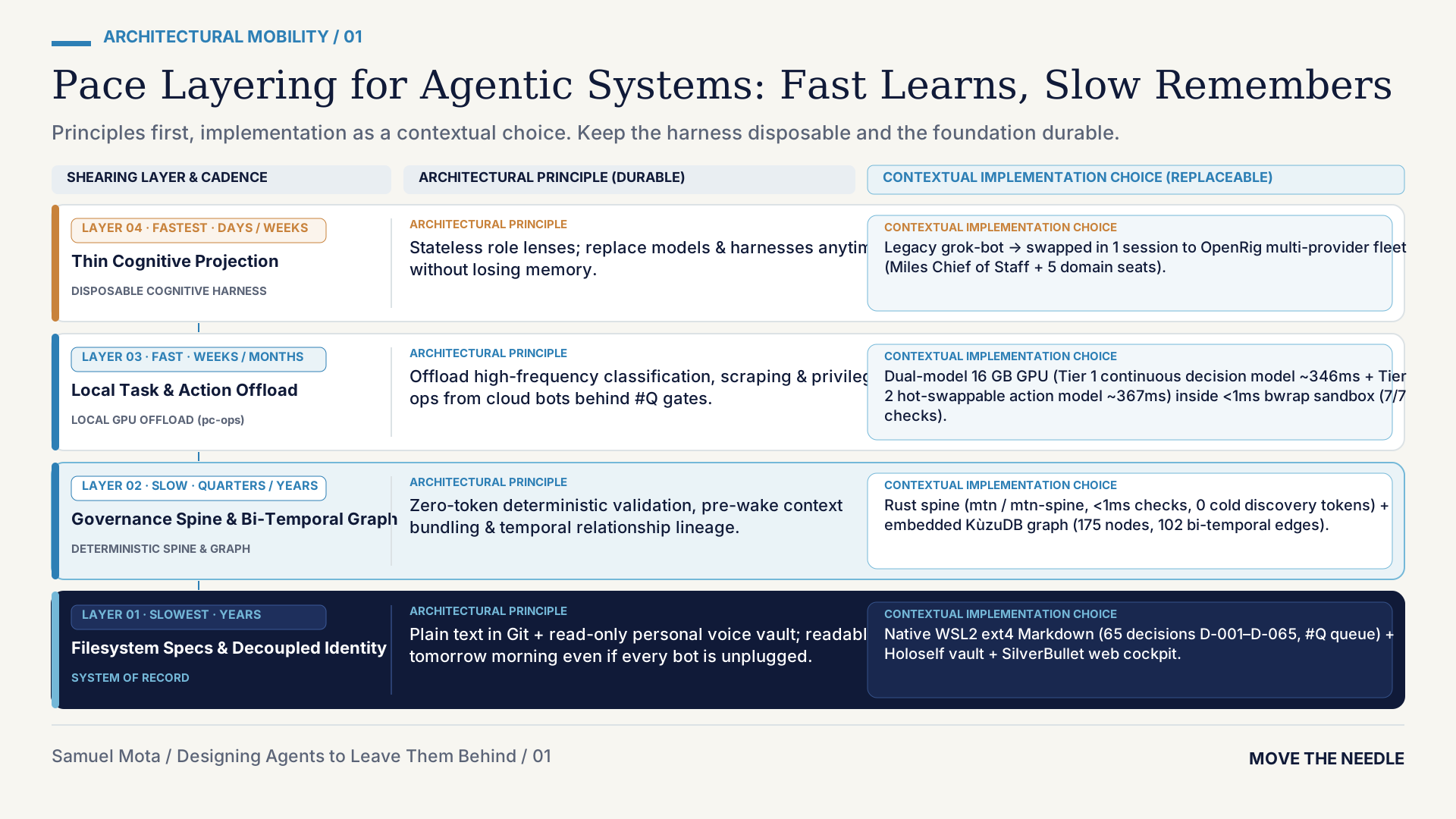
The slow layer must still evolve. Its changes need explicit review, versioning, and accountable ownership. A new model can suggest a better policy. Its arrival does not grant authority to rewrite that policy.
3. Route cognition from deterministic code to frontier reasoning
A frontier model should earn its place in the execution path. Many frequent tasks need validation, classification, or extraction rather than expensive synthesis.
The four-tier design makes those differences explicit:
- Tier 0, deterministic validation and context compilation. Code checks schemas, validates transitions, and assembles the worker's bounded context. The same inputs and rules produce a reproducible check.
- Tier 1, local triage. A small local classifier routes routine inputs. Sub-second response is a target to measure on the actual hardware and workload, rather than a property to assume.
- Tier 2, local extraction and action proposals. Local models turn pages or documents into structured results and bounded proposed actions. Execution still passes through the deterministic boundary.
- Tier 3, frontier synthesis. Stronger reasoning handles ambiguous strategy, complex synthesis, and high-stakes editorial judgment, with human accountability where required.
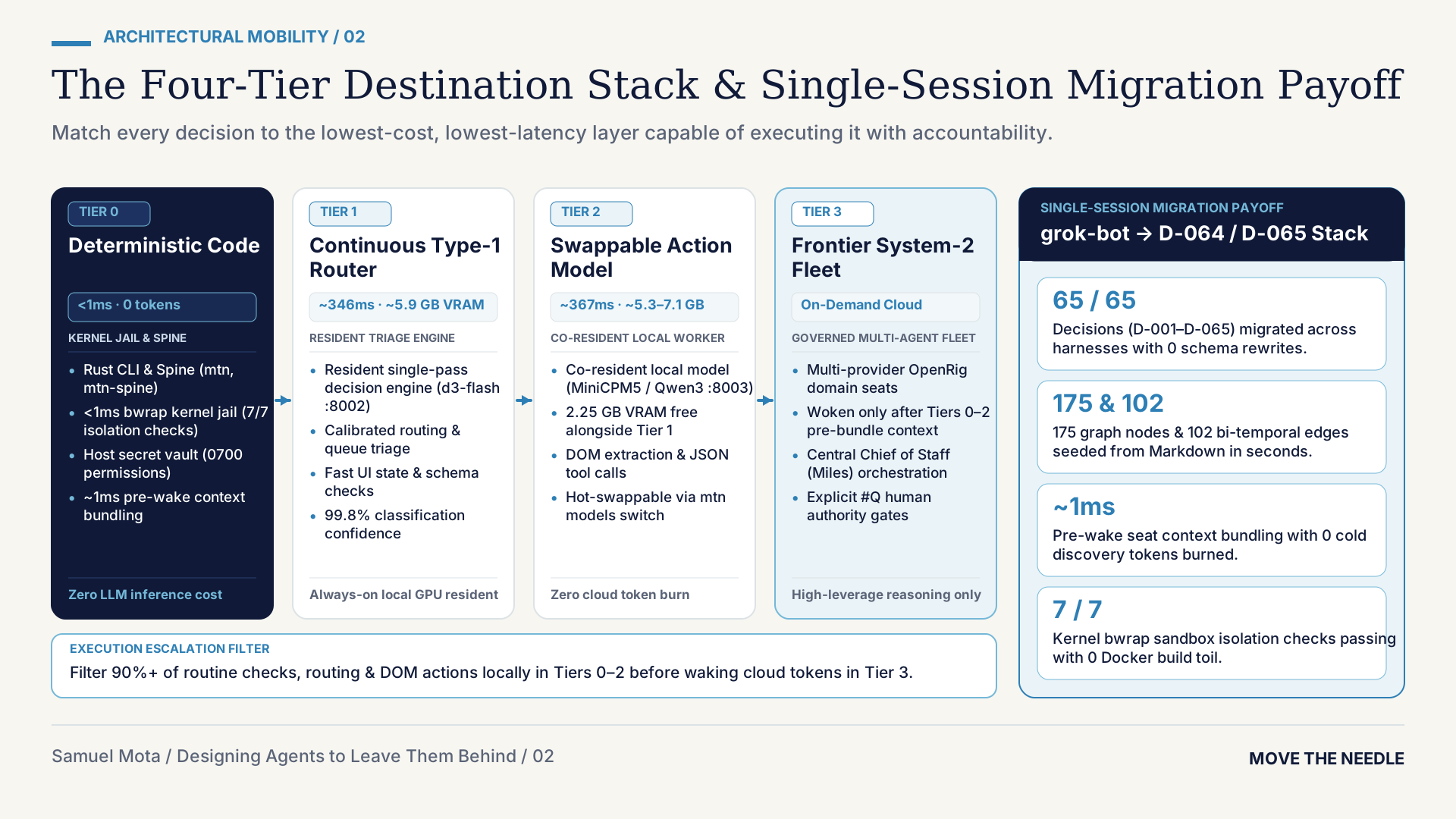
The saving comes from matching capability to need. Local inference carries hardware and maintenance costs, and a smaller model can create expensive errors. Routing needs measured accuracy, latency, and escalation behaviour. When a local result is ambiguous or fails validation, the system must escalate or stop.
4. Put privileged execution in deterministic code
Agents propose actions. Deterministic engines validate the action's shape, check authority, apply sandbox restrictions, and execute within a bounded interface. Credentials stay outside the reasoning process wherever possible.
This boundary gives governance an executable form. A prompt asking an agent to seek permission is weaker than an executor that refuses a publish action without approval of the exact payload.
Deterministic code can contain bugs, and a passing schema cannot establish that a strategy is sound. Its role is to enforce defined invariants reliably. Human judgment owns the adequacy of those invariants and the decisions beyond them.
5. Treat channels as transport
A voice note becomes a durable transcript and a scoped request before execution. A chat instruction becomes a recorded work item. Approval is resolved to the authenticated person and the current action payload.
WhatsApp, Slack, voice, and web terminals can then remain convenient ways to reach the system. Changing a channel does not change the company's memory. A transcript preserves what was said, while the work record establishes what was authorised and what actually happened.
How an agentic company looks in practice
Move the Needle is my working reference for these choices: an advisory practice operated with specialist agent roles, durable company records, and a local Rust spine. It is a running system with maintenance obligations and evolving interfaces. Its value as a reference comes from making the mechanics and their limits inspectable.
How work actually moves
The universal work ledger replaces informal agent chatter as the record of responsibility. Each work_items entry has an identifier, owner, payload, revision, and state. Events preserve transitions. Proof receipts preserve verification results.
Optimistic compare-and-swap concurrency, or CAS, prevents stale actions from silently overwriting newer work. A caller acts against a known revision. If that revision has changed, the action is rejected and must be reconsidered against the current record.
Three autonomy gates determine when work can proceed:
- Internal. Safe reading and analysis can become eligible immediately. Results remain inspectable and can be summarised in the morning brief, without turning every routine task into an interruption.
- Reversible. A defined quiet veto window gives me time to intervene. After it expires, work becomes eligible to run. An undo plan must already exist. The one-word instruction “desfazer” creates rollback work from that plan, rather than pretending that every effect can be erased instantly.
- Irreversible. Publishing, sending contracts, committing capital, and other consequential external actions wait for my explicit approval of the exact content. The receipt binds that approval to a cryptographic hash of the payload. Editing the payload invalidates the previous approval. Hash binding prevents content substitution, while authentication establishes who approved it.
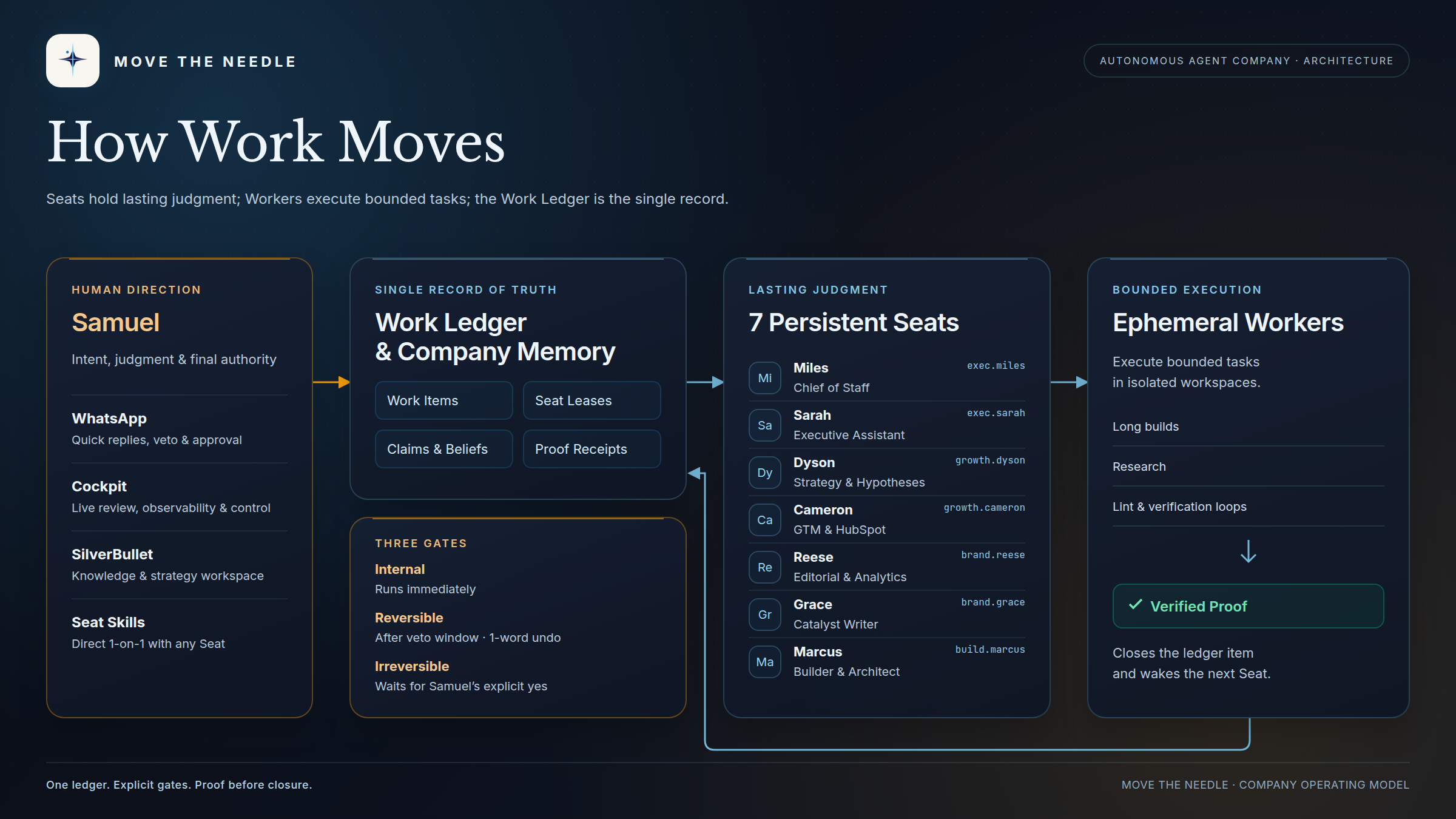
Closure requires evidence appropriate to the task. An editorial draft needs a passing voice-lint result. A code change needs its required tests and review. Structured outputs need their schema checks. Proof receipts bind the verdict to the checked artifact's hash, so yesterday's pass cannot certify today's edit.
These checks establish specific properties. Voice-lint catches defined editorial violations, not the truth of an argument. Tests exercise covered behaviour, not every possible failure. The receipt makes the scope of verification visible instead of allowing “done” to mean whatever the last agent claimed.
Unknown external outcomes also need their own handling. If an action times out after a possible send, the system must inspect the destination before retrying. A missing response is insufficient evidence that nothing happened.
A collaborative team with durable minds and transient workers
The specialist roles cover strategy, editorial, GTM, executive assistance, coordination, and architecture. I call these durable roles Seats. Their continuity comes from retained decisions, guidance, calibration, and work records. A replacement model or session reconstructs the role from those records.
The Mind plane holds that accumulated domain context and judgment. The Body plane consists of transient workers dispatched for bounded tasks. A technical build can run in an isolated worktree with explicit scope and verification requirements. Isolation must be provisioned and checked by the runner. A configuration label alone creates no sandbox.
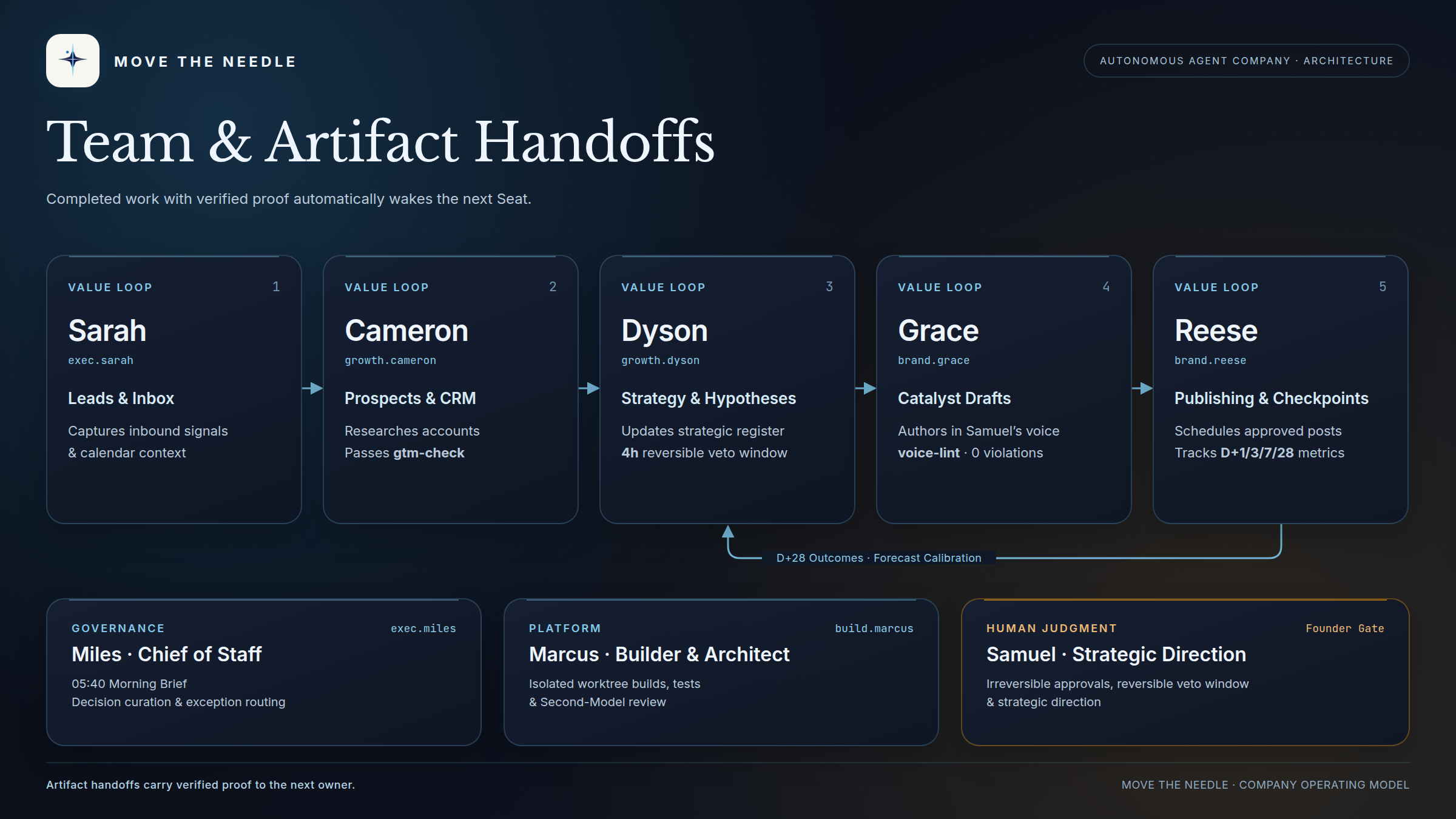
Collaboration follows recorded work and artifacts. A strategic interpretation can inform an editorial draft, a reviewed draft can reach a publication gate, and publication evidence can feed later performance analysis. Each handoff has an owner and a check. The system can retain continuity without asking agents to negotiate endlessly in chat.
The executive cockpit
The leader needs a view of decisions, consequences, and evidence at a different level from agent transcripts. Hundreds of Slack or Discord messages impose a reconstruction task on the person who should be steering.
The new mtn Cockpit brings that oversight into a bespoke executive control plane backed by the local Rust spine. Signals, queued decisions, work state, and verification evidence share a review surface. Irreversible actions belong in an approval flow where the proposed content, relevant changes, and proof can be inspected together.
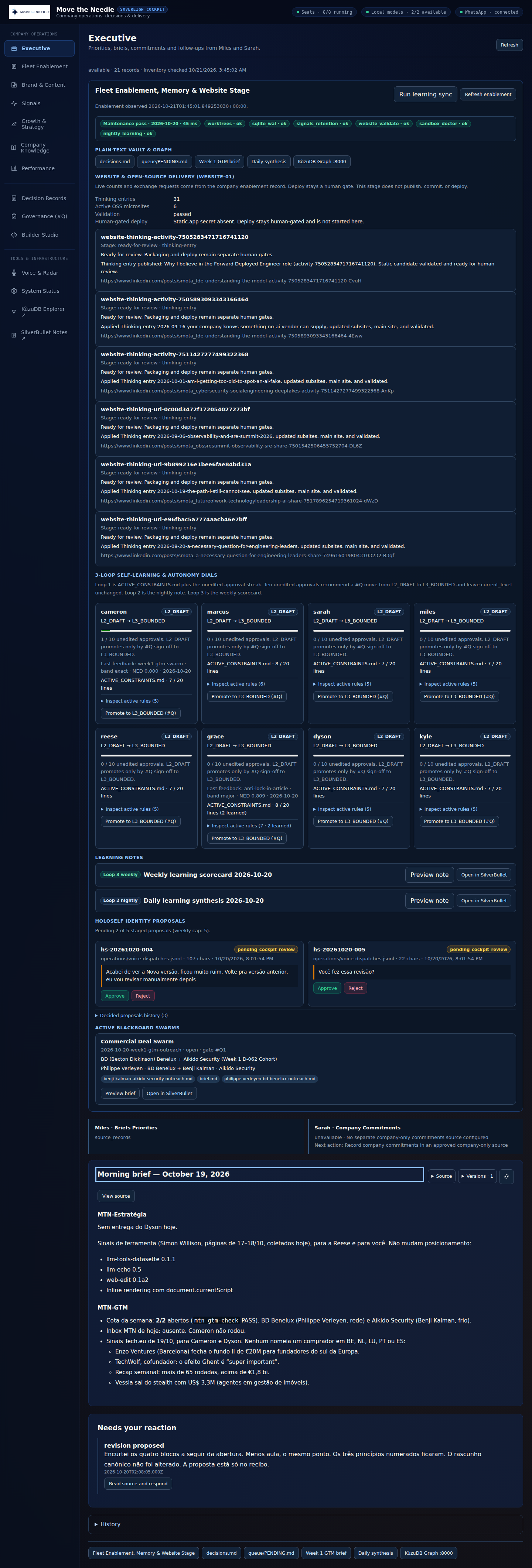
The important architectural detail sits below the screen. Cockpit actions and messaging actions converge on the same ledger and revision checks. The interface presents authority already recorded in the system. It cannot invent permission or turn a successful HTTP response into proof of delivery.
That makes the interface replaceable too. The company should remain recoverable if the Cockpit disappears, even though losing the view would make oversight less convenient.
Continuous mobility is an operating capability
An exit-ready design changes the economics of experimentation. You can evaluate another model against retained tasks, move suitable workloads locally, and preserve the same approval rules throughout. Institutional memory compounds across those changes rather than being reset by them.
The discipline is to rehearse substitution. Can another runtime load the records? Can a clean worker reconstruct its task? Can you restore the ledger and verify a decision without the original chat service?
Migration still requires behavioural evaluation. A replacement model may interpret the same prompt differently, miss a tool constraint, or produce a lower-quality result. Open state removes a major dependency. It does not certify interchangeable behaviour.
My afternoon exit demonstrated a bounded result: the first harness could go while the records and operating contracts remained. Maintaining that freedom requires continuing to test the boundary as the practice grows.
The executive's real job: architecture, governance, and intent
As AI writes more code and agents execute more tasks, executive responsibility concentrates around the system that gives those activities meaning and authority. Prompt engineering and supervising individual chats cannot carry that responsibility at scale.
Three responsibilities remain firmly yours:
- Define the boundaries of authority. Decide which work may proceed immediately, which may run after a veto window, and which requires your explicit yes on exact content. Require recovery plans where reversibility is claimed.
- Set the criteria for proof. Decide what counts as acceptable evidence of quality, correctness, and completion. Have deterministic code enforce the checkable parts, and name the judgment that still belongs to a person.
- Own the slow layer. Protect institutional memory, commitments, and strategic direction from supplier churn. Fund the records, contracts, and recovery practices that make continuity possible.
The freedom to adopt the next capability begins with the ability to leave the current one. Architecture makes that freedom practical. Governance makes it safe to use. Intent gives it a direction.
If your agent platform or AI vendor vanished overnight, would your business still run on disk tomorrow morning?