
Creating the conditions for transformation
The executive choices that turn AI capability into business value
The executive choices that turn AI capability into business value
We ask people to transform the way they work. We give them access to AI, encourage experimentation and expect better results. Yet the targets, approval processes and demands on their time often stay much the same.
How much transformation are we actually making possible?
My view is that the executive’s role is to create the conditions in which better ways of working can emerge—and then make the decisions that turn those discoveries into results. That means choosing an outcome worth improving, enabling people to change the work that produces it, and deciding how the organization will use what it learns.
In an earlier reflection, I wrote: “The truth is: nobody knows.” There is no settled model for how organizations and technology will evolve together. We still have to discern, decide and deliver while that model is taking shape.
This responsibility has a familiar foundation. Speaking at TED2014, Simon Sinek observed:
The only variable are the conditions inside the organization. That’s where leadership matters, because it’s the leader who sets the tone.
His subject was trust and cooperation amid external uncertainty. Today, that responsibility includes the conditions in which people learn to work with AI: what they can access, what they can change and what happens when they challenge the existing way of doing things.
Choose the outcome, then follow the work
A useful starting question for an executive is: what should become materially better for the business or the customer?
The answer gives transformation a direction. A customer gets a problem resolved without having to contact us again. A sound proposal reaches a buyer sooner. A production decision improves throughput while preserving quality. Each outcome depends on a sequence of activities, decisions and handoffs.
This is why I would organize transformation around end-to-end use cases. The unit of accountability should be the outcome we want to improve.
Consider a proposal that AI helps prepare in minutes. If it still spends days waiting for pricing approval, much of the potential gain remains unrealized. If the draft contains errors that require extensive checking, we may have shifted effort from the author to the reviewer. The business case needs to include both.
Following the work makes these dependencies visible. It also exposes decisions that an individual team cannot resolve: who can approve a different approach, which checks remain necessary, and whose priorities change when one function’s improvement creates work for another.
Erik Brynjolfsson put the broader requirement clearly in a recent interview:
To realize the full benefits of these powerful technologies, organizations need process changes, workforce reskilling, and sometimes new products and services.
That is a substantial executive agenda. Funding the tool is one decision. Changing the operating arrangements that determine its value is another set of decisions, often involving several functions.
The evidence supports taking workflow design seriously. In McKinsey’s 2025 survey, redesigning workflows had the strongest association with reported generative-AI impact on EBIT among 25 attributes examined. This does not establish that end-to-end transformation always produces the highest return. It does strengthen the case for looking beyond the performance of an isolated task.
An end-to-end view can lead to a very focused intervention. We may discover that one decision, one missing piece of information or one approval is the constraint. The experiment can be small while responsibility for the result covers the whole process.
Choose a use case with a credible path to value
The appeal of a technology can make almost any application sound promising. A useful use case makes the underlying business logic explicit.
“Use AI in sales” leaves that logic open. “Help customers answer product questions before they abandon a purchase” identifies a need, a possible intervention and an outcome we can observe.
The starting point matters. In randomized experiments at one online retailer, AI-assisted pre-sale support increased sales by 16.3% compared with a baseline without live pre-sale assistance. Search improvements produced a 2.9% increase; the advertising applications tested showed no statistically significant sales effect. These are results from one retailer, not a ranking of returns that every company can expect. They illustrate how much depends on the gap an application fills.
I would therefore examine an opportunity through four connected questions: Is the problem consequential? Is there usable information? Can someone act on the output? Can we verify whether the outcome improves?
Large volumes of data may help reveal patterns across many interacting variables. Existing knowledge may become more valuable when people can retrieve and apply it during their work. An underserved customer need may become economical to address. In each case, value depends on the connection between information, action and outcome.
That connection is what the executive team needs to understand before deciding where to commit attention.
Make it possible for people to change the work
Once the outcome is clear, the next question is whether the organization allows people to pursue it.
Access, authority and incentives belong in the same conversation. People need the capability to work differently, permission to exercise judgment and a reasonable basis for believing that doing so will help them succeed.
Put capability where the work happens
Providing a license creates an opportunity. Making the tool useful requires appropriate information, preparation and support within the actual workflow.
A study of 5,172 customer-support agents found that AI assistance increased issues resolved per hour by 15% on average, with larger gains among less experienced workers. The practical significance is that assistance can help people apply knowledge while handling real work. The variation in gains also matters: experienced and inexperienced colleagues may need different support and different expectations.
For leadership, this raises choices about development and deployment. Where does expertise currently sit? Who struggles to access it? Which parts of the work require practice and judgment even when assistance is available?
Those questions help turn access into capability.
Give people clear authority—and a reason to use it
An employee who receives an AI recommendation still needs to know what they are expected to do with it. Follow it? Challenge it? Adapt it? Seek approval?
Governance should make those decisions clearer. It should establish which actions people can take, where review is required, how exceptions are handled and who is accountable for the outcome. Otherwise, we can introduce a new capability while leaving people uncertain about whether they are allowed to use it.
A field experiment in a multinational pharmaceutical company makes this organizational dimension tangible. Researchers adjusted procedures, decision authority, training and incentives to fit how sales professionals interacted with AI. Tailored arrangements improved performance; untailored arrangements performed worse than the control condition. Because the changes were tested together, the study cannot tell us which single lever caused the improvement. It gives us a reason to examine the arrangement as a whole.
The corresponding executive question is uncomfortable: are our existing rules protecting the work, or making the intended change impractical?
A person measured entirely on today’s throughput may reasonably avoid an experiment that slows them down this week. A manager rewarded for local efficiency may resist a change that benefits the customer but adds effort to their department. Asking for collaboration does little to resolve that conflict.
Creating room to learn therefore involves real trade-offs. Something may need to leave the priority list. A target may need to change. A manager may need authority to accept a temporary cost in pursuit of a better overall result.
These decisions make an invitation to experiment credible.
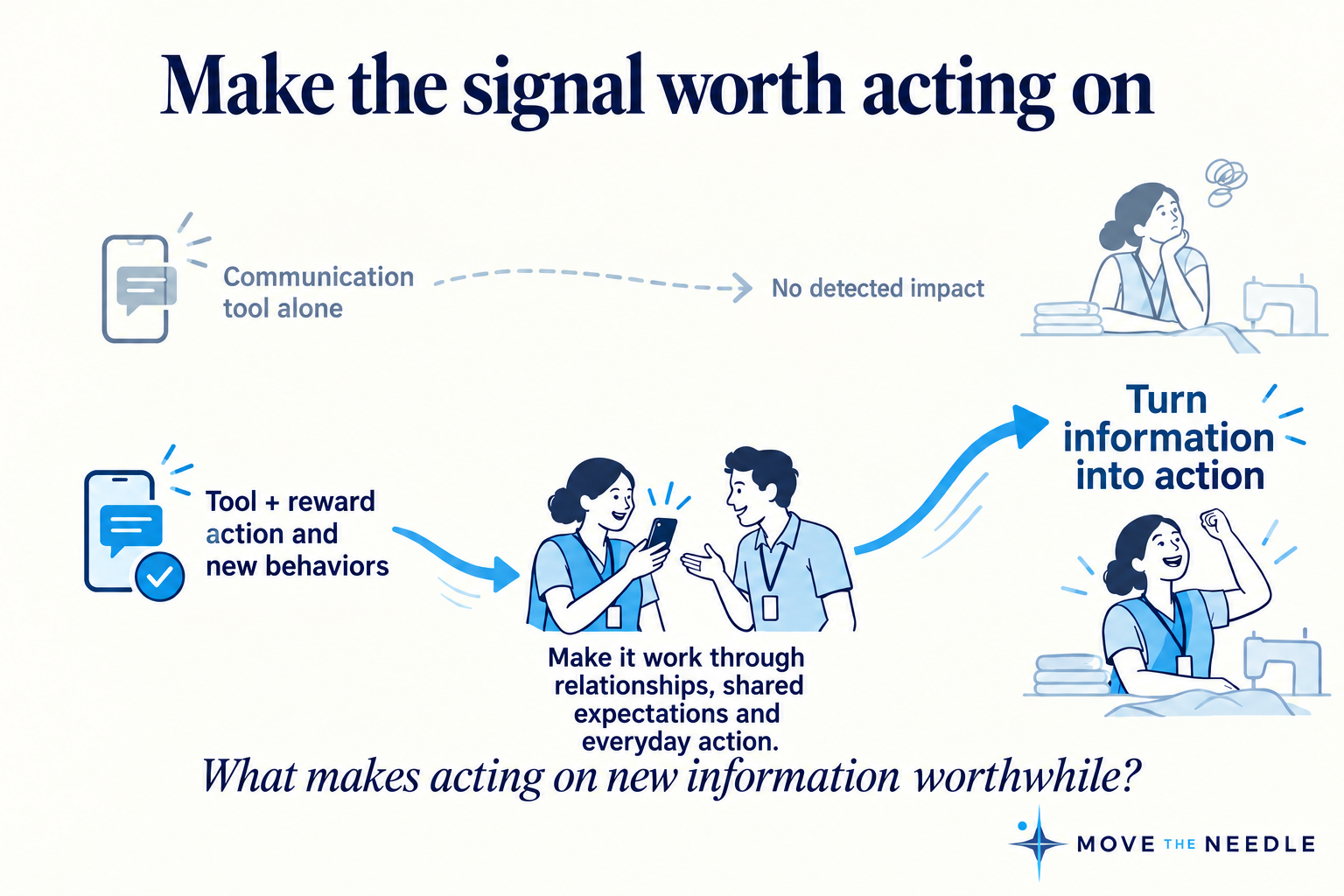
The same principle has been tested outside AI. In Indian garment factories, a communication tool alone had no detected impact. Pairing it with incentives for managers to respond effectively raised productivity by 5%. Workers raised more production issues, and managers became more responsive. The reflection for leaders is practical: what makes acting on new information worthwhile?
Turn learning into a different way of operating
An experiment produces evidence. Leadership has to decide what follows from it.
A positive result may justify a wider test, a process change or a different allocation of resources. A disappointing result may reveal a weak use case, an unsuitable tool or an organizational constraint. Discernment means understanding which explanation the evidence supports before deciding what to do next.
This is also where productivity gains need a destination.
Time released from a task can support better service, additional volume, deeper analysis or lower costs. Each requires different action. If the ambition is growth, people need work through which that capacity can serve additional demand. If the ambition is quality, they need a clear standard and permission to spend the time achieving it.
A six-month experiment across 66 firms found that AI-tool users spent about two fewer hours a week on email in the second half of the study, without a detected corresponding change in the quantity or composition of their tasks. The finding illustrates a gap leaders should examine: saving time does not automatically reorganize work.
Capturing value means making that next choice explicit—and checking whether it delivers.
Participate in the learning you expect from others
Leading by example has always been part of the job. Today, it includes using AI to prepare more thoroughly, understand unfamiliar contexts, test assumptions and raise the standard of our own work.
That experience gives us a better basis for asking questions. We become more attentive to the difference between a convincing answer and a well-supported one. We see where context matters, where verification takes effort and where a tool genuinely extends our capability.
The example also includes how we respond when an experiment fails or a colleague challenges a recommendation. People learn what is acceptable from those moments.
And proximity remains essential. We are still a team of people. A change in responsibilities can affect professional identity, confidence and relationships as much as output. Conversations with the people doing the work reveal things that a performance dashboard cannot explain: why an output is distrusted, why a workaround persists or why a new responsibility feels unsafe.
This is what it means to treat transformation as sociotechnical. Technology, expertise, authority and relationships change together. Learning has to include all of them.
Choose the next move from where you are
These arguments lead to different priorities depending on the organization’s starting point.
If you have not started, establish one credible path to value. Choose a recurring problem with a visible cost, delay or quality gap. Follow the work to the outcome it affects, establish a baseline and give a small team the tools, preparation, time and authority to test a change. Agree in advance what improvement would justify continuing, including the cost of review and rework. The first objective is to learn whether a useful change is possible in your context.
If you have several pilots but little value to show, find where the gain disappears. Take one promising pilot and trace what happens after its output leaves the team. Examine approvals, repeated checks, conflicting targets and downstream capacity. Give an owner the authority to bring the relevant functions together and test a change to the constraint. Revisit the original business need too: some pilots deserve investment, and some deserve to end.
If you already have results, decide what those results should make possible. Specify how released capacity will improve service, support growth, raise quality or reduce costs. Then test whether the gain holds across teams, customers and exceptions. Develop people for changed responsibilities, and watch where the next constraint emerges. Expansion should deepen your understanding of how the result is produced.
None of these starting points offers a universal recipe. Practices that have worked elsewhere give us options worth testing. Our responsibility is to understand what works here, why it works and what needs to change as the organization learns.
When AI frees capacity, what are we choosing to make possible—and what are we changing so that it can happen?
---
Sources and further reading
1. [Simon Sinek at TED2014 — official TED coverage](https://blog.ted.com/leadership-is-about-making-others-feel-safe-simon-sinek-at-ted2014/)
2. [Erik Brynjolfsson, Is the AI productivity story at a turning point?](https://www.mckinsey.com/capabilities/people-and-organization/our-insights/is-the-ai-productivity-story-at-a-turning-point). McKinsey Talks Talent, July 2026.
3. [McKinsey, The state of AI: How organizations are rewiring to capture value](https://www.mckinsey.com/capabilities/quantumblack/our-insights/the-state-of-ai-how-organizations-are-rewiring-to-capture-value). March 2025.
4. [Fang et al., Generative AI and Sales Productivity: Field Experiments in Online Retail](https://arxiv.org/html/2510.12049v6). June 2026.
5. [Brynjolfsson, Li and Raymond, Generative AI at Work](https://digitaleconomy.stanford.edu/publication/generative-ai-at-work/). Staggered rollout among 5,172 customer-support agents.
6. [Krakowski et al., Human-Centered Artificial Intelligence: A Field Experiment](https://doi.org/10.1287/mnsc.2022.03849). Combined intervention involving procedures, authority, training and incentives.
7. [Dillon et al., Shifting Work Patterns with Generative AI](https://www.nber.org/papers/w33795). Six-month randomized experiment involving 7,137 workers at 66 firms.
8. [Adhvaryu et al., Organizational Incentives and the Returns to Technology Adoption](https://www.nber.org/papers/w35445). NBER working paper, July 2026.