
Agents Made the SDLC Conscious Again
Building Ativaly with agents led me to a simple conclusion. The faster implementation becomes, the more deliberate the delivery system around it must be.
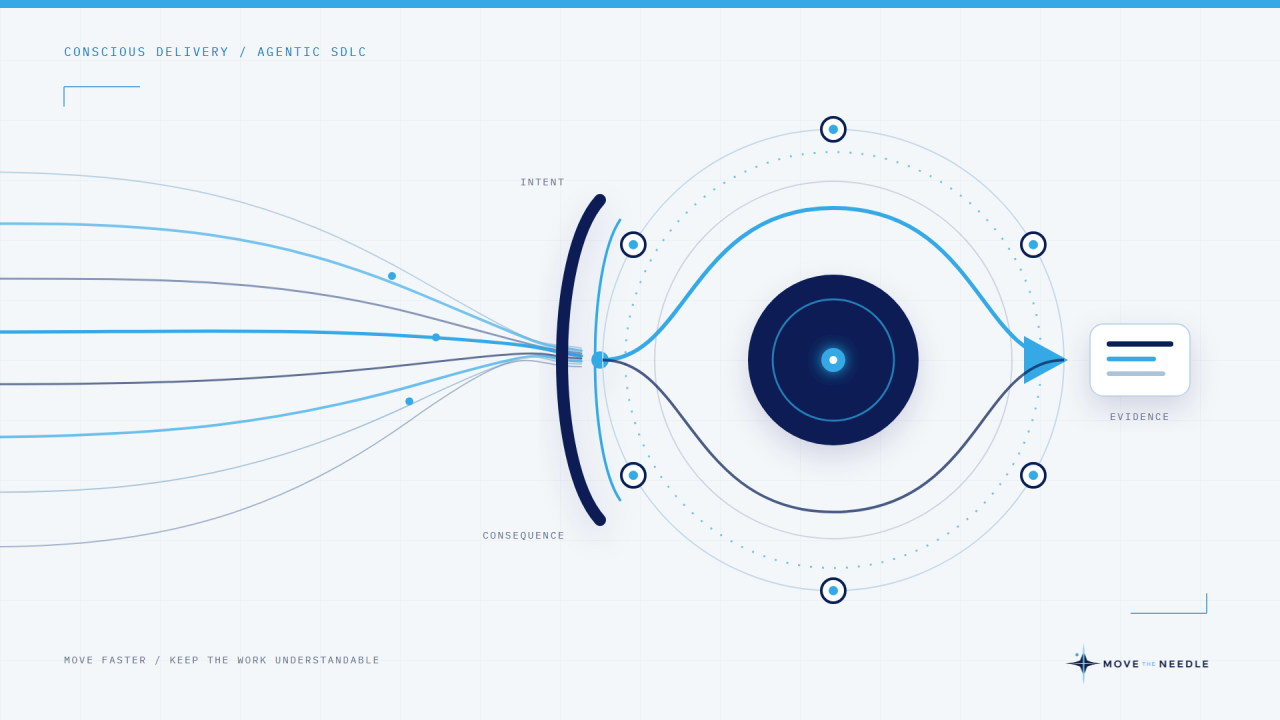
Building Ativaly with agents led me to a simple conclusion. The faster implementation becomes, the more deliberate the delivery system around it must be.
Agentic delivery therefore increases the value of SDLC, although it changes what the lifecycle needs to accomplish. The emphasis shifts from organising work into a sequence of formal stages to keeping the connection between intent, decision, implementation, validation and ownership understandable while all of them move faster.
This matters because implementation time is collapsing while decision quality remains a human responsibility. A plausible interpretation can become a coherent working system before the organisation has properly examined the tradeoff behind it. The management challenge is shifting from whether software can be produced to whether the people responsible for it can still explain how and why it came to exist.
The experience revealed three connected changes: SDLC needs to become lighter and evidence-native, product ownership and architecture need to move further upstream, and agent collaboration needs to improve decision quality without creating a second layer of operational noise.
Together, these changes point towards what I call a conscious SDLC.
Speed makes the purpose of SDLC more visible
My appreciation of SDLC comes partly from working in highly regulated pharmaceutical environments. When the consequences of failure are material, an understood end-to-end delivery system makes work explainable, repeatable, auditable and recoverable. It preserves the reasoning behind a decision, the authority under which it was made, the validation that supported it and the response required when an assumption proves wrong.
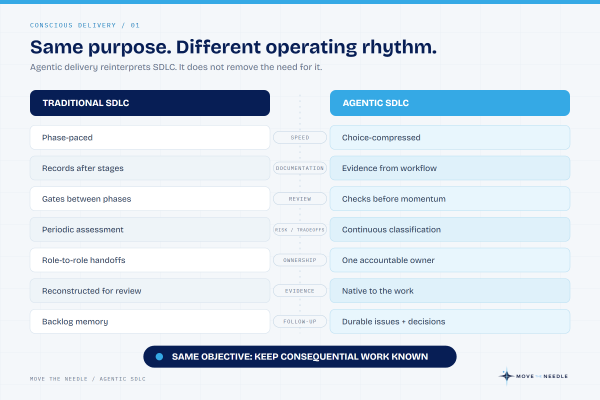
The familiar weakness is that this discipline can become detached from its purpose. Teams experience templates, approvals and stage gates as ceremony when the evidence is assembled after the work or when a complete document hides an incomplete decision. The process then adds time without increasing understanding.
Agentic delivery creates the same underlying need in a different operating rhythm. Decisions accumulate more quickly and their effects travel through the system sooner. The appropriate response is a lighter lifecycle in which evidence is produced with the work and remains available after the agent session has ended.
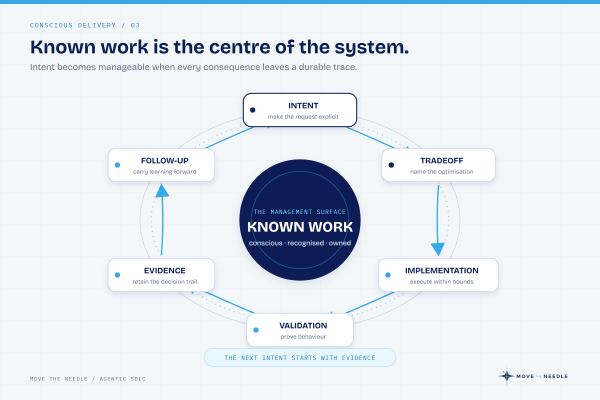
This is what it means for work to remain known. The intent is explicit enough to guide execution. The tradeoff is visible enough to review. The implementation stays within an agreed boundary. Validation supports confidence, and the resulting evidence gives the next decision a reliable starting point.
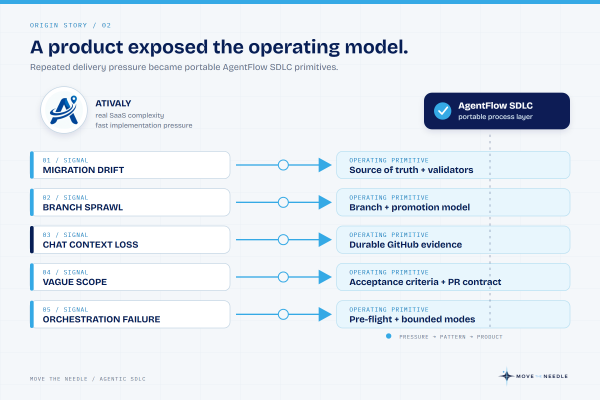
Ativaly made this need concrete. It was a real multi-tenant SaaS product spanning a public storefront, operational roles, orders, catalogue availability, WhatsApp handoffs, delivery zones, routing, Postgres migrations, staging environments and role-specific documentation. A local product choice could affect data boundaries, permissions, operational handoffs and deployment behaviour at the same time.
As the product grew beyond 1,100 issues and pull requests, recurring delivery problems began to form a pattern. Migration assumptions drifted from the actual source of truth. External CI failures exposed the need for deterministic local validation. Bug fixes lacked sufficient regression evidence, while work branches and temporary agent artefacts accumulated. Multi-agent reviews also failed when tools, permissions or runtime context had not been checked in advance.
Each incident could be treated as a local defect. Taken together, they showed that the delivery system was not consistently separating temporary reasoning from durable evidence, project rules from framework rules, or implementation confidence from validated behaviour. Agent speed did not create these distinctions, but it made the cost of leaving them unclear more visible.
Product ownership and architecture move upstream
The first management consequence is that product ownership becomes more important as implementation becomes cheaper. The cost of producing a solution falls faster than the cost of choosing the wrong problem.
Before agents, an unclear request often generated enough meetings, questions and delay to expose some of its ambiguity before implementation. That friction was inefficient, but it created resistance. An agent can move through the ambiguity by selecting a plausible interpretation and producing a technically coherent result. By the time the mismatch becomes visible, the solution already has momentum.
Product ownership must therefore increase the resolution of intent before execution begins. Bounded scope, acceptance criteria, explicit exclusions and a clear definition of done provide the agent with freedom inside a deliberate decision. They also protect the work from useful but unrelated discoveries that would otherwise expand the active scope. Those discoveries still matter, but they belong in explicit follow-up rather than inside an implementation that keeps changing its own purpose.
Architecture moves upstream for a related reason. Its role expands from evaluating the structure of the application to designing the path through which change can move safely. In Ativaly, this meant making sources of truth explicit, separating framework-owned assets from product-owned policy, defining branch and promotion rules, choosing which controls could be deterministic and identifying where human judgement remained necessary.
The migration process illustrates the difference. Correcting one migration would have addressed the immediate failure. Establishing the authoritative migration system, documenting that decision, reconciling the live environment and validating the new path addressed the delivery mechanism that allowed the failure to recur.
The same logic governed the extraction of Ativaly's working rules into a reusable framework. The framework had to improve the delivery system without overwriting the domain, security and stack-specific constraints of the product using it. Ownership boundaries were therefore part of the architecture rather than an implementation detail.
Product ownership and architecture are solving complementary parts of the same problem. Product ownership gives intent enough resolution to constrain accelerated execution. Architecture gives the resulting change a safe and understandable route through the system.
AgentFlow SDLC emerged as an operating model
The working rules developed inside Ativaly eventually became AgentFlow SDLC, an opinionated process layer for AI-assisted software delivery. It emerged from product pressure rather than from an attempt to design a methodology in isolation.
The recurring delivery problems shaped its primitives. Migration drift led to explicit sources of truth and deterministic validation. Branch sprawl led to a defined promotion model. Lost chat context led to durable GitHub evidence. Unclear scope led to acceptance criteria and pull-request contracts. Late review led to role-based checks before implementation had acquired momentum. Failures in agent orchestration led to pre-flight checks and bounded collaboration modes.
These mechanisms sit around an existing project through roles, issue standards, handoff contracts, hooks, validators, pull-request evidence and human gates. AgentFlow does not replace the stack or introduce a hosted control plane. It gives people and agents a shared path through the work, with enough structure to preserve understanding without forcing every project into heavyweight governance.
Its promise is deliberately concise: Move faster. Keep the work understandable.
The operating loop moves from intent through tradeoff, implementation, validation, evidence and follow-up. Each stage preserves what the next stage needs to make a better decision. The centre of the model is known work, because the value comes from retaining coherence across the lifecycle rather than from the number of agents participating in it.
This also changes how multi-agent delivery should be designed. Specialist agents can improve analysis, critique architecture, test assumptions or examine sensitive surfaces, but adding agents is not an objective in itself. One accountable owner should retain the end-to-end context and use additional intelligence only where uncertainty or risk warrants it.
The practical measure is the smallest sufficient collaboration. A focused advisory review may resolve one architectural uncertainty. A security red-team may be appropriate for a consequential surface. Parallel discovery may help with a broad repository, while an isolated experiment may reduce uncertainty around a difficult refactor. In each case, the accountable owner synthesises the findings and preserves the decision.
This keeps the management surface compact. A reviewer needs to understand why specialist input was used, which option was selected, what dissent remained and how validation changed as a result. The internal topology of the agents and the volume of their discussion add little value once that evidence has been captured.
Evidence follows the same principle. The issue retains the request and acceptance criteria. The design record preserves the consequential tradeoff. Commits and branches show the implementation path. Validators record what was checked, while the pull request carries the review contract and follow-up issues preserve what remained outside scope.
This is Compliance-as-Emergent-Property applied beyond formally regulated software. Delivery confidence comes from evidence embedded into the workflow, not from an agent reporting confidence in its own output.
MetaSkills addresses the adjacent capability layer
Once delivery roles and evidence became portable, the next question concerned the capabilities participating in that delivery system. MetaSkills emerged to address that layer.
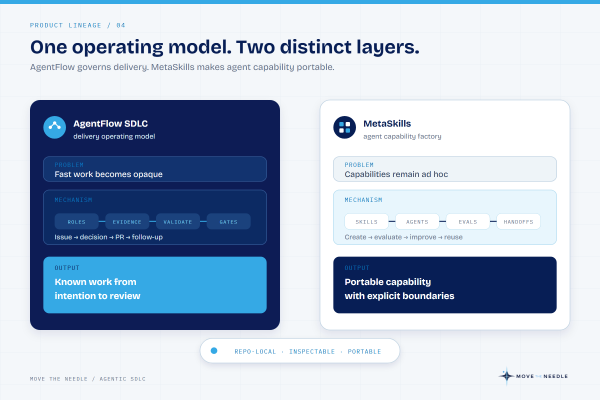
AgentFlow governs how work moves from intention to review. MetaSkills helps create and package the agents and skills that take part in that flow. Their design includes explicit boundaries, knowledge sources, permissions, fallbacks, handoff contracts, evaluations and improvement mechanisms. Activation rules also describe when a capability should remain inactive, because restraint is part of reliable behaviour.
The distinction matters. Automation without a defined agent contract is as fragile as code without an operating model. A reusable agent capability is more than a prompt. It is a bounded product with an understood role in the wider system.
AgentFlow therefore makes delivery capability governable, while MetaSkills makes agent capability portable. They address different layers of the same requirement for inspectable, repository-local and accountable work.
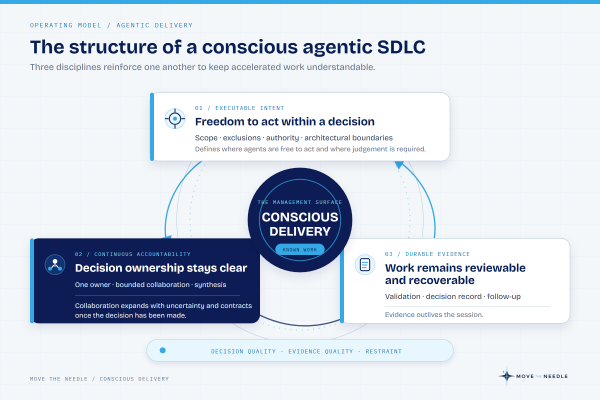
The structure of a conscious agentic SDLC
A conscious agentic SDLC works when three disciplines reinforce one another.
The lifecycle begins with executable intent, where acceptance criteria, exclusions and decision authority provide enough precision to guide implementation without prescribing every detail. Architecture then defines the relevant sources of truth, ownership boundaries, promotion paths, validation mechanisms and human gates. Together, they establish where the agent is free to act and where the system requires a deliberate decision.
Continuous accountability governs how the work proceeds. One owner remains responsible for scope, synthesis and the final decision even when specialist agents contribute. Collaboration expands only when it reduces material uncertainty, and it contracts again once the decision has been made. This prevents agent activity from becoming a parallel operating structure that people must manage in addition to the delivery itself.
Durable evidence completes the model. Tests, schemas, hooks, validators and branch rules provide deterministic controls where possible. Decision records, review conclusions and follow-up issues preserve the judgement that cannot be reduced to a mechanical check. Temporary reasoning can remain local, while the enduring record contains what another person needs to review, resume or audit the work.
These disciplines also create a useful standard for maturity. An agentic delivery system should be evaluated by the quality of its decisions and evidence, as well as by its restraint. Avoiding an unnecessary agent, tool call, loop or artefact can be as important as using one well.
The leadership implication
Agents compress the distance between intention and consequence, which makes agentic delivery an operating-model question rather than only a tooling decision.
At the executive level, this means deciding where authority remains human, which evidence deserves organisational trust and how much control is justified by the consequence of failure. That authority model gives architects the basis for designing safe paths and boundaries, while product owners provide the resolution of intent that keeps speed from amplifying ambiguity. Engineering teams can then work with durable context without becoming spectators of agent activity.
The leadership task is to maintain coherence while the system moves faster. That requires less attention to the volume of work produced and more attention to whether consequential choices remain visible, owned and recoverable.
More than six decades before generative AI and coding agents, J. C. R. Licklider described the intended division of responsibility in human-computer collaboration:
“Men will set the goals, formulate the hypotheses, determine the criteria, and perform the evaluations.”
Licklider was not writing about the systems we now call agentic AI. The technology has changed radically, but the foundation has not: machines can extend the reach of human work, while people remain responsible for purpose, criteria and judgement.
Agents have made the original purpose of SDLC visible again. As execution accelerates, leadership must keep the work conscious.