From Product Capability to Platform: When Reuse Changes the Operating Model
The tradeoff between local velocity and shared scale in non-tech enterprises
The tradeoff between local velocity and shared scale in non-tech enterprises
In a non-tech enterprise, a capability should become a platform only when the system-level advantage is large enough to outweigh the loss of local fit, the additional coordination layer, and the need for persistent funding. Platform is not a maturity label; it is a choice about architecture, ownership, and operating model.
The first platform decision is not buy or build. It is whether the capability should become a platform at all.
In their essay Mind the Platform Execution Gap , Thoughtworks practitioners Cristóbal García García and Chris Ford draw on experience leading engineering organisations and working across product and infrastructure teams to frame platform strategy as an execution challenge, not simply an architectural one:
“Platforms take considerable investment in terms of money, talent and opportunity cost.”
That is the lens for this article. The argument unfolds in four steps:
Define the boundary: what makes a capability a platform, and why the economics differ outside technology companies. Compare ownership models: keeping the capability inside a product versus extracting it for shared use. Examine extraction: the lifecycle, operating tensions, and investment model that follow. Test the choices: a hypothetical observability scenario covering build, buy, and hybrid approaches.
Most platforms begin as capabilities inside a product or business solution. A team needs identity, telemetry, workflow orchestration, data access, document processing, experimentation, payments, integration, or an AI service, so it designs the capability for its own outcome and evolves both together. Complex products abstract technical complexity in this way all the time without calling the result a platform, and that is often the right design because the team retains the shortest path between business context, technical decision, and operational consequence.
The platform question appears when a second product needs a similar capability, followed by a third. The enterprise can allow each team to build its own version, or it can extract a common capability, give it an independent lifecycle, and ask several products to depend on it. That choice is more consequential than moving code into a shared repository: it changes who the customers are, how priorities are set, where costs sit, what service commitments exist, who owns migration, and how technical choices interact with multiple business roadmaps.
I see this directly while building a reliability and observability platform across a global enterprise estate with petabyte-scale data, trillions of time-series events, and tens of thousands of assets. The volume makes the technology difficult, but it does not make it a platform. What makes it a platform is that many products and business solutions depend on the same underlying capability while carrying different priorities, risk profiles, architectures, and delivery commitments.
Definitions matter
The industry often uses “platform” as shorthand for cloud infrastructure or an internal developer platform, but the concept is broader. A platform can be any underlying technical capability intentionally provided for use by multiple products, applications, or solutions. It may sit low in the stack, such as cloud infrastructure, identity, networking, integration, or observability, or closer to the business domain, such as a customer-data service, payment capability, experimentation engine, content service, or regulated evidence workflow.
What defines it is not the technology or its position in the stack, but the relationship with its consumers. A product or solution serves a business or external-user outcome; a platform serves other products and teams so that they can produce those outcomes more effectively.
My working definition is:
A platform is a productized, reusable capability with explicit consumers, interfaces, service expectations, and long-term ownership.
That definition excludes several things commonly described as platforms. A library used by one product remains a component, while a centrally installed tool operated through tickets may be a shared service without becoming a useful platform. Even a vendor product purchased enterprise-wide becomes part of a platform only when the organization defines how products consume it, who owns the integration, which controls are embedded, and how the capability evolves. A platform is therefore both an architectural layer and an operating model.
Why platform economics differ in non-tech enterprises
“Tech-native” and “non-tech” are not maturity categories. Banks, pharmaceutical companies, manufacturers, airlines, and retailers operate technology estates of enormous scale and sophistication; the difference lies in how technology investment connects to the business model.
In a technology company, software is usually the product or the mechanism through which it is delivered, so a stronger platform can improve the core product engine directly. Teams release faster, experiments reach customers sooner, reliability protects digital revenue, and infrastructure efficiency affects unit economics. In a non-tech enterprise, the causal chain is longer: the platform first improves an application, engineering team, data product, operational system, or business solution, which must then influence a commercial, manufacturing, clinical, financial, supply-chain, or regulatory outcome.
The value remains real, but it is more indirect, distributed, and difficult to attribute. A business-facing product normally has a visible sponsor, a defined deadline, and an outcome that can be explained in its own language, while a shared platform concentrates cost in one place and allows benefits to surface later across many products, functions, and countries. The technology may be equally sophisticated; the investment logic is not equally direct.
Three structural differences follow.
The consuming products have stronger external clocks
Business solutions are driven by market events, regulatory commitments, country launches, manufacturing needs, customer expectations, and operational deadlines, while the platform roadmap is driven by reuse, resilience, standardization, technical health, and future capability. Both clocks are legitimate, but when portfolio pressure rises the business-facing deadline usually wins, leaving the platform funded well enough to remain a dependency but not necessarily well enough to become a Scale Engine.
The estate contains more exceptions
Acquisitions, regional suppliers, legacy applications, outsourcing agreements, data residency, and multiple regulatory classifications make the common core harder to identify. Copying a platform model from a more homogeneous technology company and treating every exception as resistance misses the distinction between historical debt and legitimate business context; the architecture must be able to tell them apart.
The value is distributed
The platform cost is visible in one budget, while the benefits appear across the products that consume it. A business solution can point to a direct outcome, whereas a platform usually contributes through capacity released, repeated cost avoided, risk reduced, resilience improved, or future product delivery accelerated.
This makes long-term investment commitment harder before adoption reaches critical mass and creates a predictable funding asymmetry: consuming products can defend their next business milestone, while the platform must defend the future performance of a portfolio. These economics should frame the extraction decision from the start rather than appear later as a justification for it.
Two legitimate ways to own a capability
When a capability supports a product, the organization can keep it inside the product or solution boundary, or extract it as an explicit platform capability consumed by several products. Both approaches are legitimate, and neither is inherently more mature; they place speed, accountability, dependency, and long-term cost in different parts of the system.
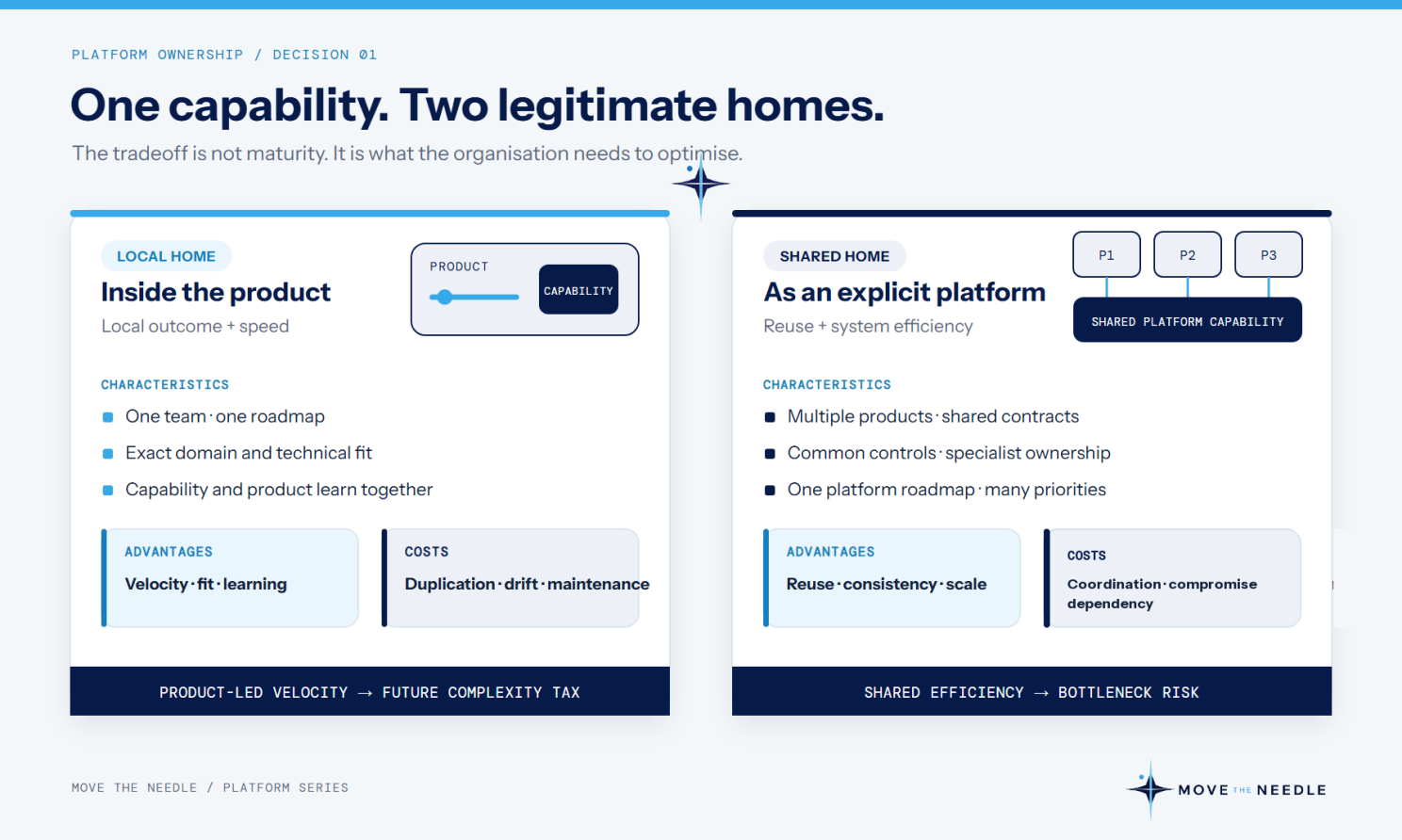
The boundary changes where speed, accountability, dependency, and long-term cost sit.
Keep the capability inside the product
The embedded approach optimizes for local outcome and speed. Because the same team owns the business requirement, application, capability, and operational consequences, it can design for the precise domain model, latency profile, regulatory classification, user experience, and release cadence that the product needs.
In a non-tech enterprise, this model often remains rational for longer than platform advocates expect. The product has a direct business sponsor and an external clock. Keeping the capability local preserves the shortest path from a business requirement to a working solution, especially while the domain is still being learned.
The left side of the comparison captures the immediate advantage: accountability, learning, and prioritization remain within one team and one business context. The future cost is less visible because it accumulates across the estate as similar implementations diverge, controls are repeated, specialist knowledge is spread thinly, and later integration becomes harder. Keeping a capability local protects Product-Led Velocity, but it can also create a future Complexity Tax.
Extract the capability as a platform
The platform approach optimizes for reuse and system-level efficiency by concentrating specialized knowledge, implementing common controls once, and spreading improvements and costs across a broader consumer base. In return, product teams can direct more of their own capacity toward the business outcomes that differentiate them.
The right side of the comparison shows the inversion. Reuse, consistency, and scale improve, but dependency becomes explicit. The platform team must manage contracts, versions, migrations, extension points, and priorities across several consumers. No product gets a perfect fit, and the central cost becomes visible before the distributed value.
The capability may therefore become more reusable and less locally optimal at the same time; that is not a design failure, but the core tradeoff.
The visual makes those costs visible. It cannot decide whether the common core is stable enough, or the shared advantage large enough, to justify the additional coordination layer. That is the threshold question.
The recurring lifecycle: product capability to platform
The ownership boundary rarely changes in a single step. A capability usually moves from a local implementation to repeated implementations, then toward some form of shared component before the organization decides whether it warrants the team, contracts, funding, and lifecycle of an explicit platform.
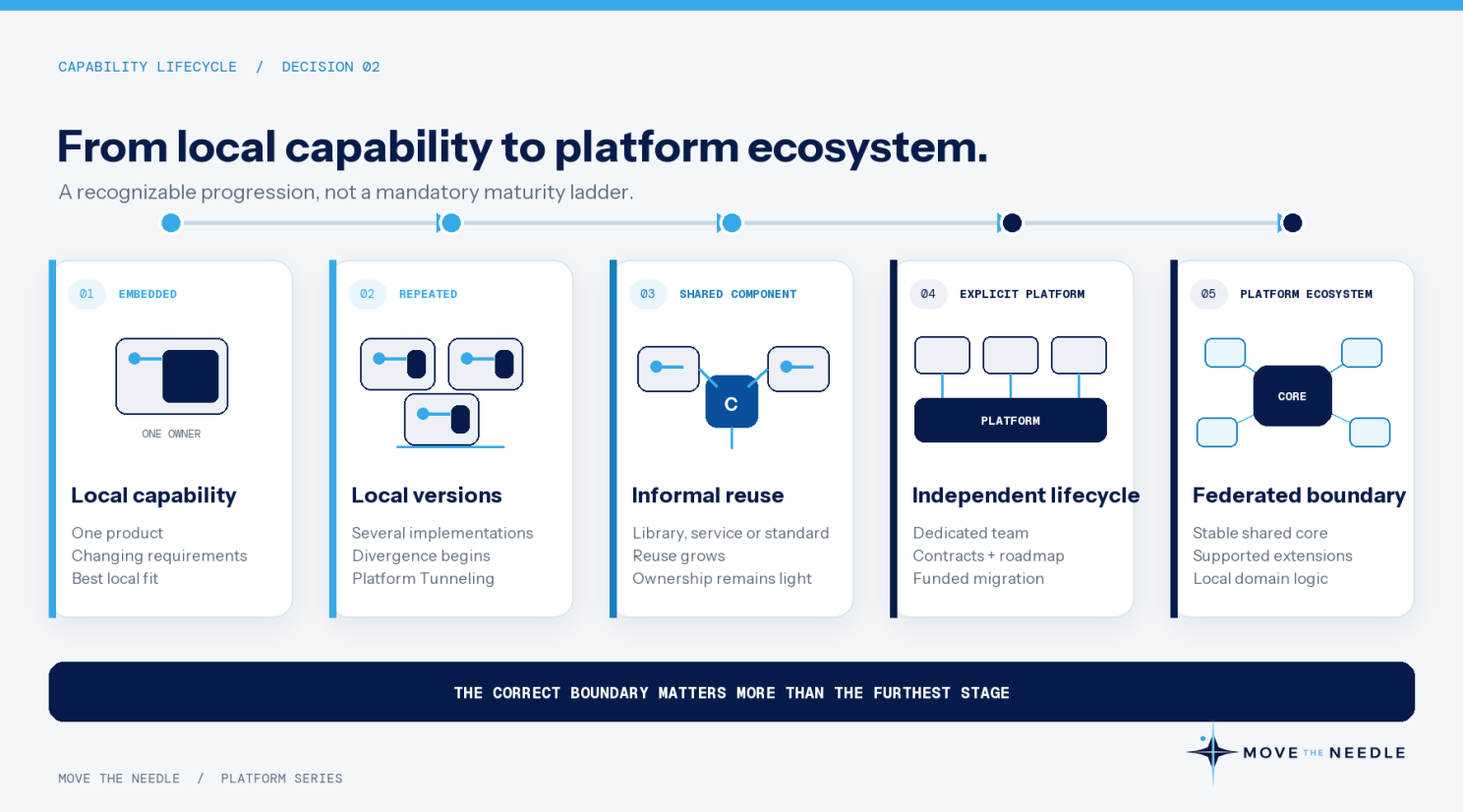
The progression is not a maturity ladder. Each stage can be the correct boundary when the next step would create more coordination than value.
Not every capability should reach the explicit-platform stage. Some create more value as embedded product components, others should remain shared libraries or services, and only some justify a fully operated platform and federated ecosystem. Maturity lies in choosing the right boundary, not in maximizing the number of platforms.
When should a capability become a platform?
Reuse alone is not enough, and two products using similar code do not automatically justify a platform team, product manager, service model, and multi-year roadmap. The threshold should be especially demanding in a non-tech enterprise because extraction adds a coordination layer between teams carrying direct business commitments and a capability whose value will be realized through them. The shared advantage must be large enough to justify that extra distance, which I would test through six conditions.
1. There are multiple real consumers: The consumers must be products or solutions with funded demand, recurring use, and a meaningful cost if each implements the capability independently, not hypothetical users in an architecture deck. A platform built for imagined scale usually spends its first years searching for customers.
2. The common core is becoming stable: If the capability is still changing rapidly as the first product learns the domain, extraction may freeze the wrong abstraction. The boundary becomes credible only when repeated implementations reveal which parts are genuinely common and which belong at the product edge. Premature platformization generalizes uncertainty, while late platformization institutionalizes duplication; the right moment is contextual, but the common pattern should be visible before it is standardized.
3. Repetition is economically material: The duplicated cost must be large enough to justify the new coordination cost, and the calculation must include more than development: operations, support, security, audit evidence, supplier management, infrastructure, incident response, upgrades, and the opportunity cost of scarce specialists solving the same problem in several places.
A platform is defensible when the cost of coordinating duplication becomes higher than the cost of coordinating a shared dependency.
4. The shared capability carries common risk: Identity, observability, data access, integration, security policy, and evidence generation often qualify because inconsistent implementations create enterprise risk. A platform can make their controls an architectural property rather than a repeated review exercise, creating Compliance-as-Emergent-Property: products inherit well-designed controls through consumption instead of recreating them through local process.
5. The capability can have a credible contract: Consumers need to know what the platform provides, what remains their responsibility, what service levels apply, how changes are versioned, how incidents are handled, and where exceptions live.
If those boundaries cannot be explained, the platform will become either a ticket queue or an unowned dependency.
6. The enterprise will fund persistent ownership: Extraction creates a product whose customers are other products, which means it needs engineering, product management, operations, support, adoption, a roadmap, and the authority to reject requests that belong in a consuming product rather than in the shared core.
If the organization will fund only the initial build, keeping the capability inside the product may be the more honest decision.
The hardest part begins after extraction
Before extraction, one business roadmap drives the capability; afterwards, the platform serves several products whose priorities are determined by different business contexts.
In a technology company, those priorities may still converge on the same digital product and a relatively tight commercial feedback loop. In a non-tech enterprise, the consumers may support entirely different value chains, regulatory regimes, geographies, and operating models. They share a capability, not necessarily a business clock.
One product may need speed for a market deadline, another a control required by a regulator, a third a specific latency or data-residency profile, and a fourth functionality that is valuable to its customers but irrelevant to every other consumer. Each request is rational, yet together they do not naturally form a coherent platform roadmap. Three recurring tensions follow.
The common-core problem: If the platform accepts every consumer-specific request, it becomes a collection of special cases that is harder to operate than the duplication it replaced; if it supports only the largest common denominator, it becomes too generic to be useful. The answer is not perfect standardization, but a deliberate boundary between:
a small, stable shared core; configurable policies and supported variations; extension points owned with clear standards; domain-specific logic that remains in consuming products.
A platform should be opinionated about what must be shared and explicit about what should remain local.
The roadmap problem: Product priorities are pulled by direct business outcomes, while platform priorities reflect aggregate demand, long-term health, risk, and reuse. The product that needs a platform change today will usually value it more than the products that must absorb the resulting complexity tomorrow.
The loudest consumer cannot become the platform strategy.
A credible model needs transparent prioritization based on breadth of demand, business criticality, risk, architectural coherence, and cost of delay. It also needs capacity for platform health that no consumer is likely to sponsor directly.
The velocity problem: Products often experience extraction as a loss of control because a change that once required a local design decision may now involve a platform request, interface review, coordinated release, and migration plan. The system can become more efficient while an individual consumer becomes slower.
That is why self-service, clear interfaces, useful defaults, versioning, and escape hatches matter. They are not merely developer conveniences, but the mechanisms that prevent shared capability from becoming central delay.
The platform must reduce more coordination than it creates.
The business case needs a contribution model
A platform should not claim ownership of every business result produced by its consumers; it should show how it contributes through a traceable chain:
Platform capability → change in a consuming product or team → product or solution outcome → operational or business-process change → core business contribution
In a technology company, some of these steps can collapse into one another because the consuming product is the core business. In a non-tech enterprise, they usually remain separate. That is why platform measurement needs evidence at each layer rather than a heroic claim that the platform created revenue, reduced risk, or improved a patient, customer, or manufacturing outcome on its own.
For an observability platform:
consistent telemetry and service ownership improve detection and diagnosis; better diagnosis reduces recovery time and dependence on a few experts; faster recovery reduces the duration and operational cost of business disruption; shared telemetry also strengthens evidence, capacity planning, and investment decisions.
For a data platform:
common access, quality, lineage, and policy reduce repeated data engineering; product teams reach trusted data sooner; business solutions can deliver analytics, automation, or AI capabilities faster and with clearer controls.
For a developer platform:
supported delivery paths reduce waiting and cognitive load; engineering teams spend more capacity on product outcomes; products move from decision to safe production with less repeated work.
DevEx matters greatly in this last example, but it remains one platform value space rather than the definition of platform itself.
The measurement model should follow four layers:
Platform health: reliability, cost, support demand, technical coverage, service-level performance. Consumer value: adoption, task success, integration effort, satisfaction, and ability to operate independently. Product effect: capacity released, time saved, failure reduced, controls inherited, and delivery constraints removed. Business contribution: faster milestones, lower disruption, reduced risk, cost avoided through reuse, and future optionality.
The platform earns investment when those layers connect.
Common failure modes
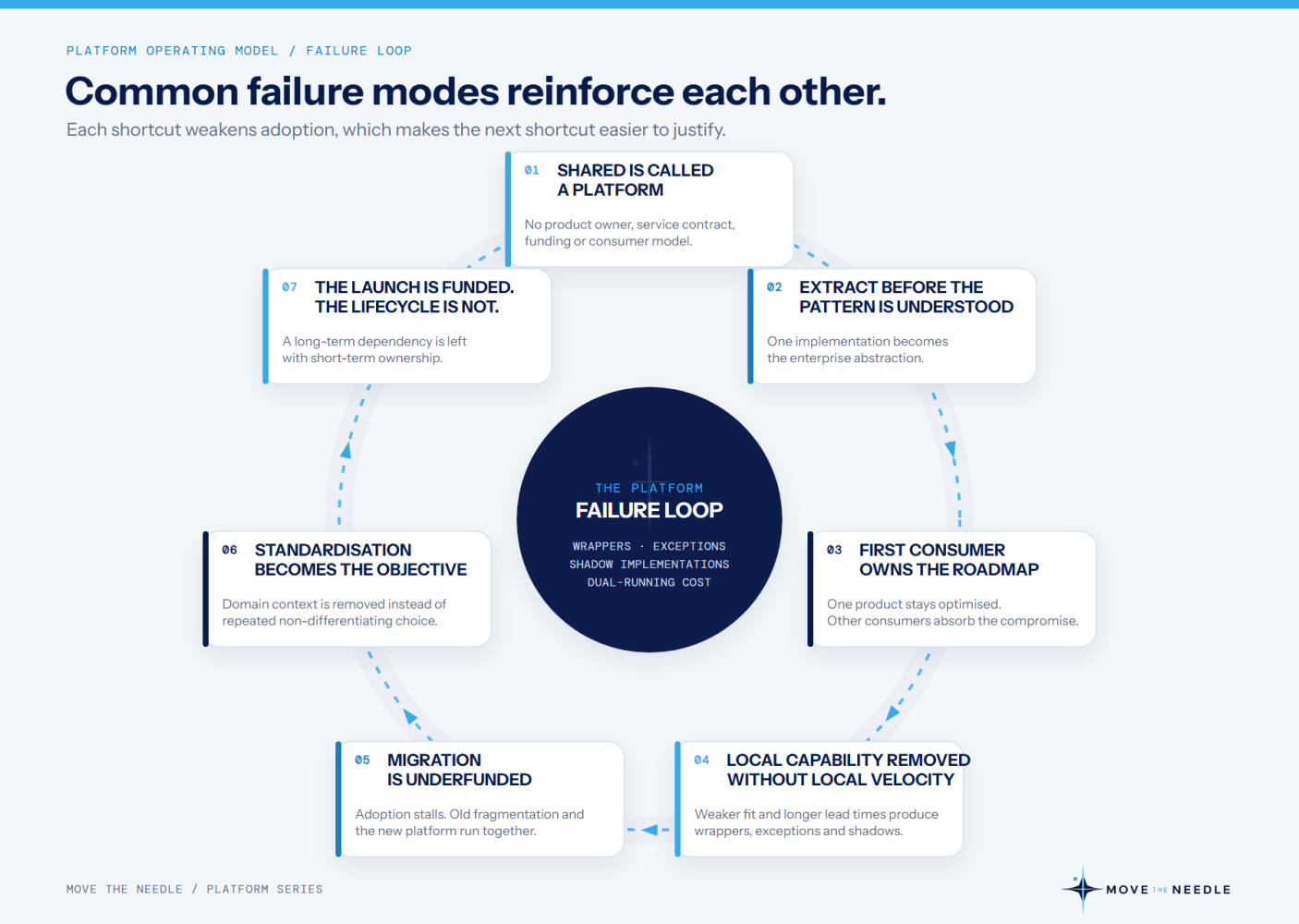
Read clockwise. The sequence matters because each decision makes the next one easier to justify.
It often starts by calling shared tooling a platform before a product owner, service contract, funding model, or real consumer pattern exists. The first implementation then becomes the enterprise abstraction, and its original product continues to shape the roadmap.
Other teams are asked to adopt a capability with weaker fit, longer lead times, and no credible extension mechanism. They respond rationally with wrappers, exceptions, shadow implementations, or a quiet return to local ownership.
If migration is not funded in the consuming products, adoption stalls and old implementations remain. The enterprise now pays for both the platform and the fragmentation it was meant to replace.
Standardization can harden the cycle when it removes domain context rather than repeated, non-differentiating choice. Funding only the launch completes it: a long-term dependency is created with short-term ownership, before adoption and operational maturity have had time to compound.
Observability: when product capability becomes shared infrastructure
Every product needs to understand its own behaviour. A team can meet that need locally through telemetry, dashboards, alerts, and incident diagnosis, preserving technical fit and a short path from failure to change.
The platform question appears when telemetry standards, collection, storage, retention, access control, cost allocation, and incident context become shared concerns across many products. Extracting them can improve consistency and economics, but it also creates a dependency serving products with different architectures, criticality, regulatory classifications, and priorities. This is no longer tooling consolidation. It becomes part of the enterprise’s ability to detect, understand, and recover from technology failure.
A hypothetical enterprise scenario
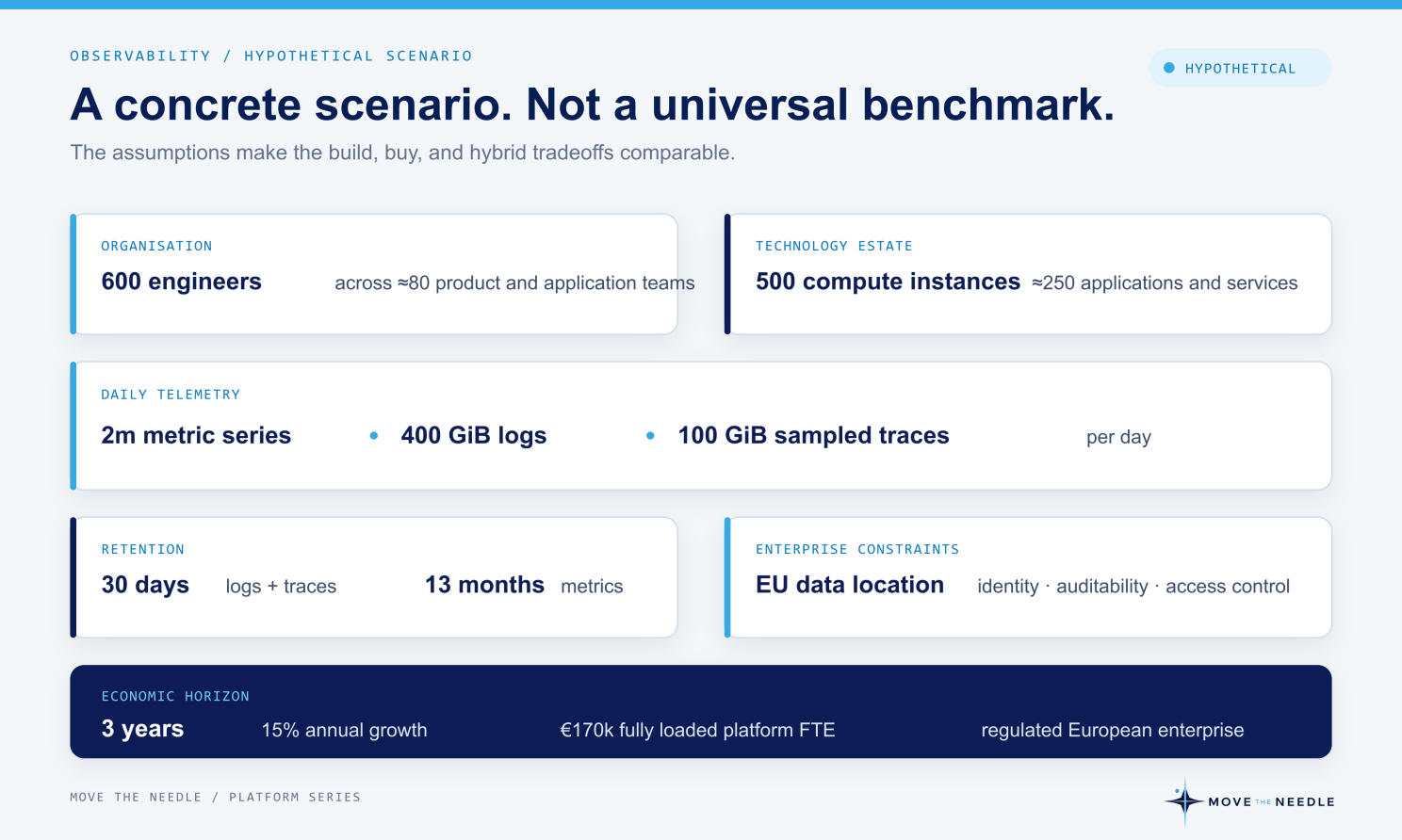
The scenario is entirely hypothetical. It is not an anonymised company example, an actual supplier proposal, or a universal benchmark. Public rates, translated using the European Central Bank reference rate on 17 July 2026, make the tradeoffs concrete.
The comparison assumes equivalent platform scope: instrumentation, collection, storage, dashboards, alerting, service-level objectives, onboarding, tenancy, security, cost controls, resilience, support, upgrades, and adoption.
Three ways to provide the capability
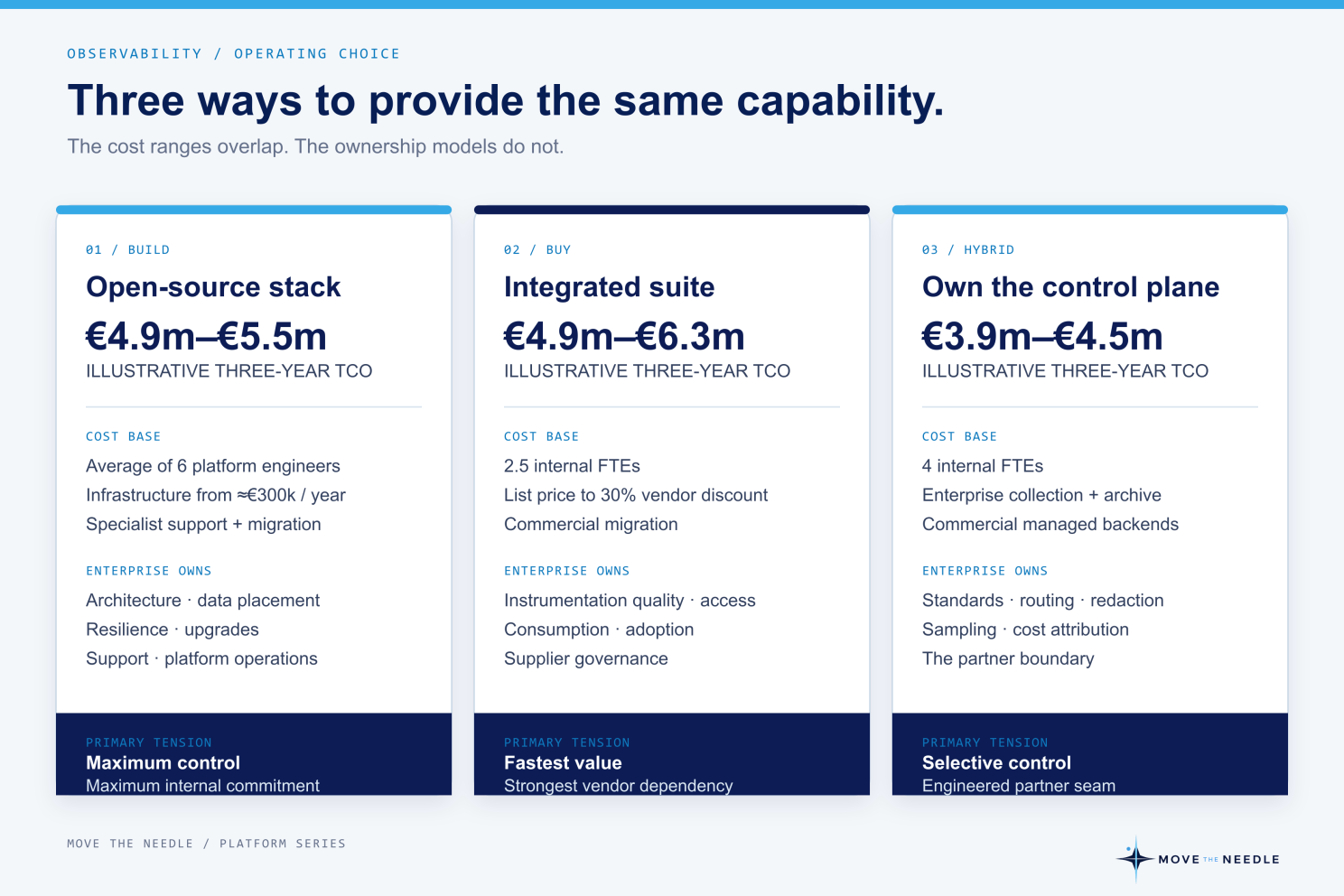
The ranges overlap enough that the point estimate should not decide the architecture. A seventh sustained engineer adds €510,000 to the build case over three years, while a 30% commercial discount removes most of its apparent open-source saving.
The more important distinction is where complexity sits. Build maximises control but consumes scarce engineering and management capacity. Buy usually provides the shortest time to value, but transfers neither accountability nor judgment to the supplier. Hybrid retains control of the telemetry contract while a product partner operates the scale-sensitive backends.
In this scenario, hybrid has the lowest estimated TCO. That is not a universal result, and it does not make hybrid simple. It creates a seam that must be engineered, secured, supported, and governed over time. Hybrid does not remove complexity; it chooses which complexity the enterprise should own.
The non-economic tradeoffs often decide first
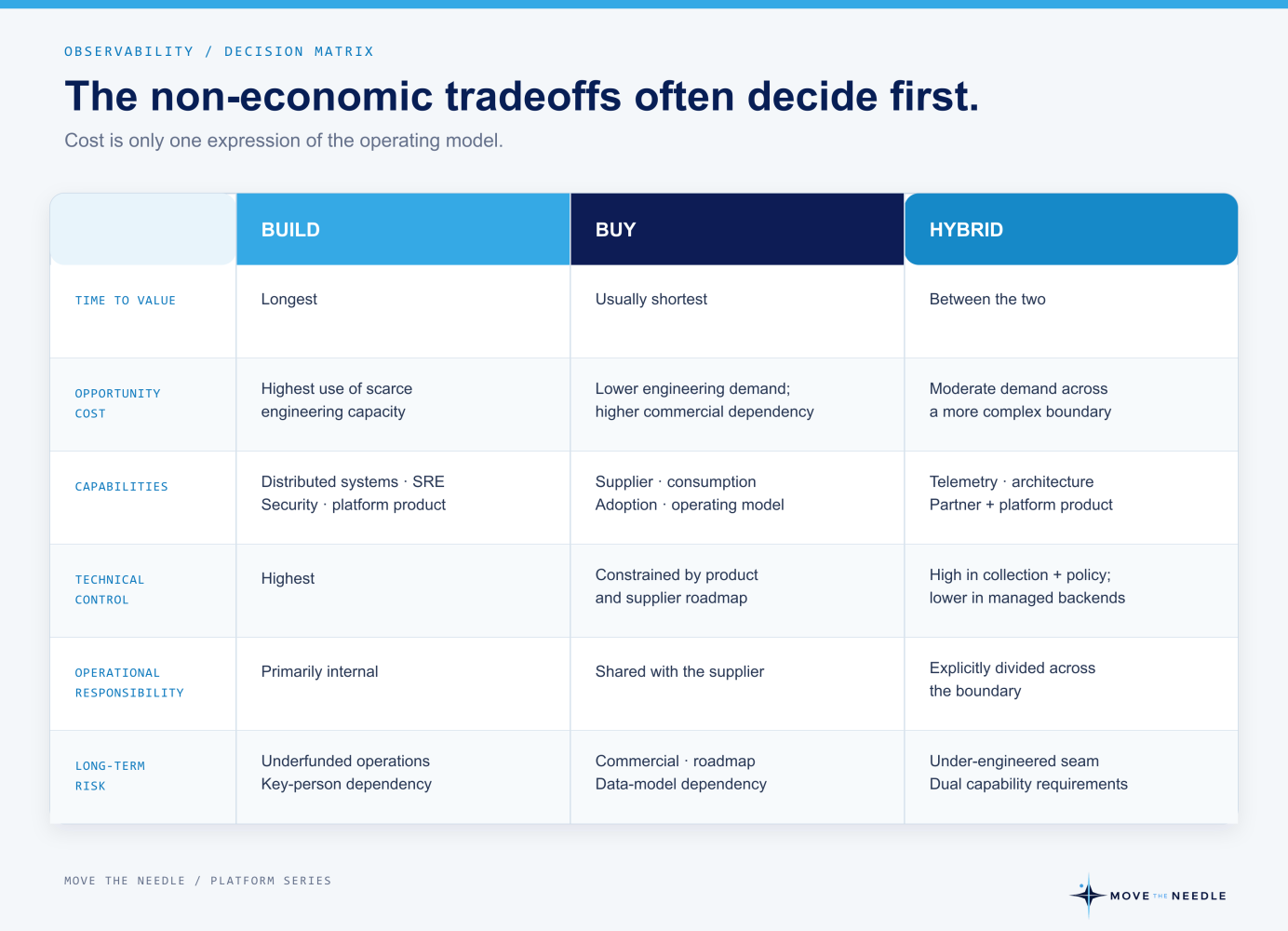
Management capability matters as much as technical capability. Build requires leaders able to sustain a specialist team and protect a multi-year technical roadmap. Buy requires consumption governance, commercial discipline, and enough internal expertise to challenge the supplier rather than outsource judgment. Hybrid requires both.
Interoperability is part of the economics
Buy and hybrid decisions should be tested for openness before price, an area where SaaS products are often weaker than they first appear.
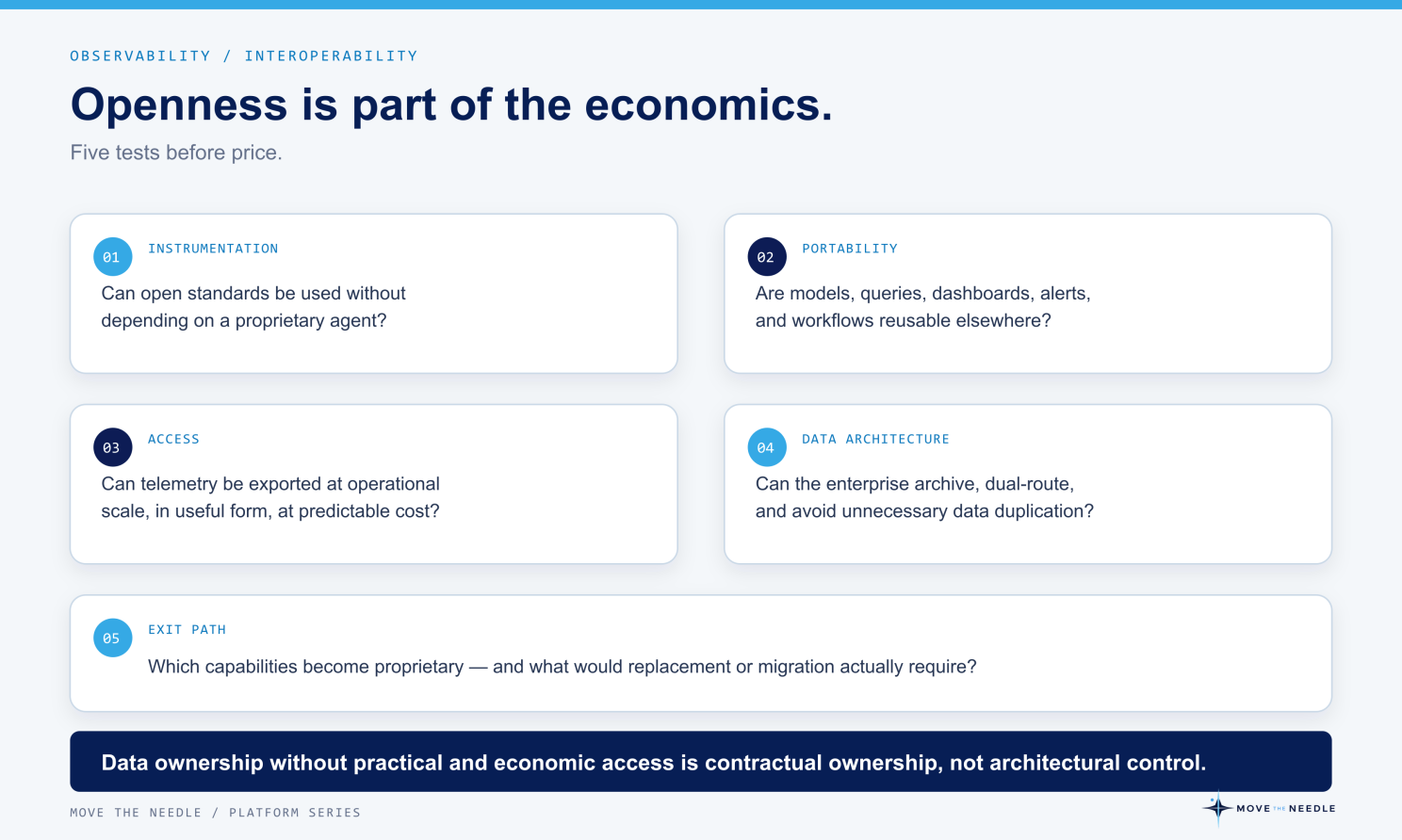
OpenTelemetry reduces instrumentation and collection lock-in, but it does not make the rest of the operating model portable. Without practical access, the enterprise may pay to ingest its data, retain it, export it, transfer it, duplicate it, and reconstruct its context in another analytics, security, data, or AI platform.
Some supplier dependency can be rational. The failure is allowing it to emerge without understanding what has become proprietary or pricing the exit path. Data ownership without practical and economic access is contractual ownership, not architectural control.
The commitment outlives the annual plan
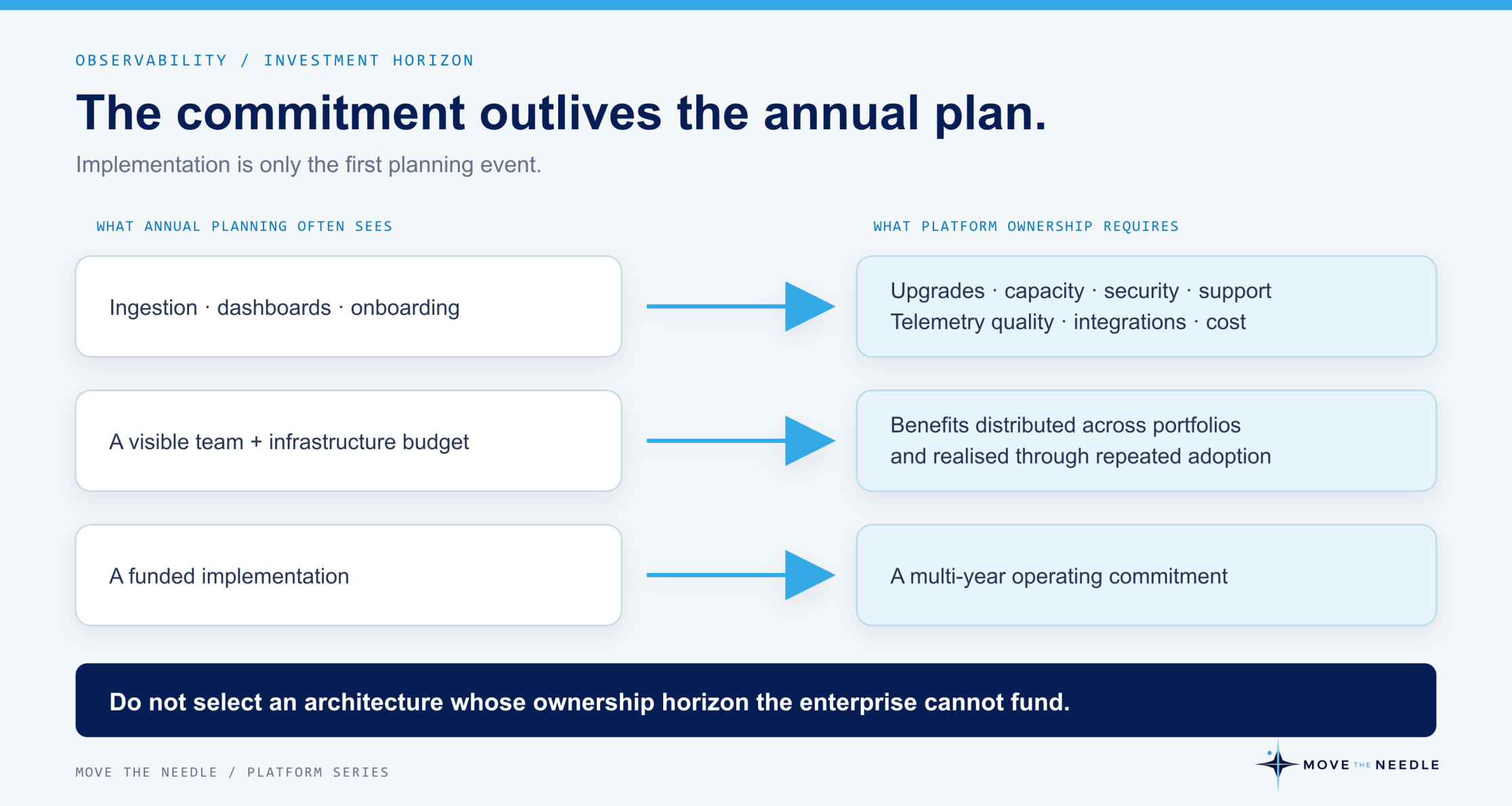
The costs arrive before the full benefits. Early funding creates the shared capability; repeated adoption, better instrumentation, operational maturity, and product-level changes create the enterprise value. Yearly planning can therefore fund the platform well enough to become a dependency, but not well enough to become a Scale Engine.
If the enterprise cannot sustain several years of ownership, it should not select an architecture that depends on that commitment.
The conclusion is not that hybrid is always correct. It is that buy versus build is not a software-pricing exercise. It is a decision about time, opportunity cost, management capacity, data control, operating responsibility, and which dependencies the enterprise is prepared to carry.
My take: extract carefully, compose pragmatically
The embedded-versus-platform decision comes before buy versus build . Keep a capability inside a product while the domain is changing, local fit remains strategically important, reuse is speculative, or the organization cannot support a shared lifecycle without slowing the business outcome; extract it when multiple real consumers share a stable core, repeated cost is material, common controls create value, and the enterprise is prepared to operate the capability as a product.
For a non-tech enterprise, I would add one more test: can the organization explain and sustain the longer value chain between the platform investment and the business outcomes it enables? If not, the technical case may be sound while the operating model remains fragile.
Once the platform decision is made, my preference is composition: buy commodity capabilities where a strong product partner can provide maturity, specialist support, regular upgrades, and faster time-to-value.
That preference depends on interoperability because a managed product that is open at ingestion but closed at export is not a neutral component; it is an architectural commitment whose switching and data-reuse costs need to be understood before adoption.
Build the layers that express the enterprise’s specific risk model, domain contracts, legacy integrations, data boundaries, and regulatory obligations, while ensuring that the partner’s roadmap does not become the platform strategy.
The enterprise should continue to own:
the target architecture and platform boundary; the stable core and supported extension model; the definitions of services, ownership, data, and controls; the data contracts, interoperability standards, and practical ability to export and reuse enterprise data; prioritization across consuming products; the internal value model and product roadmap; portability and exit assumptions for critical workflows.
There will be no perfect fit if the organization is serious about its engineering choices. The missing 10 or 20 percent may represent legitimate differences between the products consuming the platform, and the discipline lies in deciding whether those differences belong in the shared core, in a supported extension, or back inside the product where they originated. The platform should provide capability inside the product architecture without absorbing the product’s business context.
The boundary is the strategy
Platform strategy is often presented as a decision to centralize, but the more useful question is what to centralize.
Keep too much capability inside products and the enterprise pays the Complexity Tax through duplication, divergence, and repeated controls; extract too much into platforms and it pays a coordination tax through generic abstractions, competing roadmaps, slower local decisions, and central bottlenecks.
The architecture that scales is not the one with the most platforms, but the one that identifies the stable capabilities many products should share, protects the domain choices that should remain local, and funds both sides of that boundary honestly.
That discipline is particularly important outside technology companies. A platform will rarely compete with a business-facing solution on immediacy. It has to earn long-term commitment by making its contribution visible across the portfolio without pretending that indirect value is direct.