
The AI Efficiency Paradox: Why Developer Experience Just Became a Board-Level Issue
Generative AI changed one part of software engineering almost overnight: code is now much cheaper to produce. What did not become cheaper is understanding that code, validating it, securing it, integrating it, and operating it inside the realities of a complex enterprise.
Generative AI changed one part of software engineering almost overnight: code is now much cheaper to produce. What did not become cheaper is understanding that code, validating it, securing it, integrating it, and operating it inside the realities of a complex enterprise.
That is the paradox many leadership teams are beginning to feel. On the surface, engineering appears faster. Demos arrive earlier, pull requests multiply, and AI copilots can generate functional code in seconds. Yet many organizations do not feel structurally faster at all. They feel noisier. Review queues grow, architectural drift becomes harder to contain, security teams are drawn in later, and senior engineers spend more of their time verifying output they did not write themselves.
This is why Developer Experience, or DevEx, has moved out of the engineering basement and into the boardroom. DevEx is not a perk or a cultural extra; it is the operating environment that determines how efficiently an idea becomes production-grade software. In the AI era, that environment is no longer a local tooling question. It is a business system. Designed well, it allows AI to compound throughput. Designed poorly, it allows AI to compound disorder.
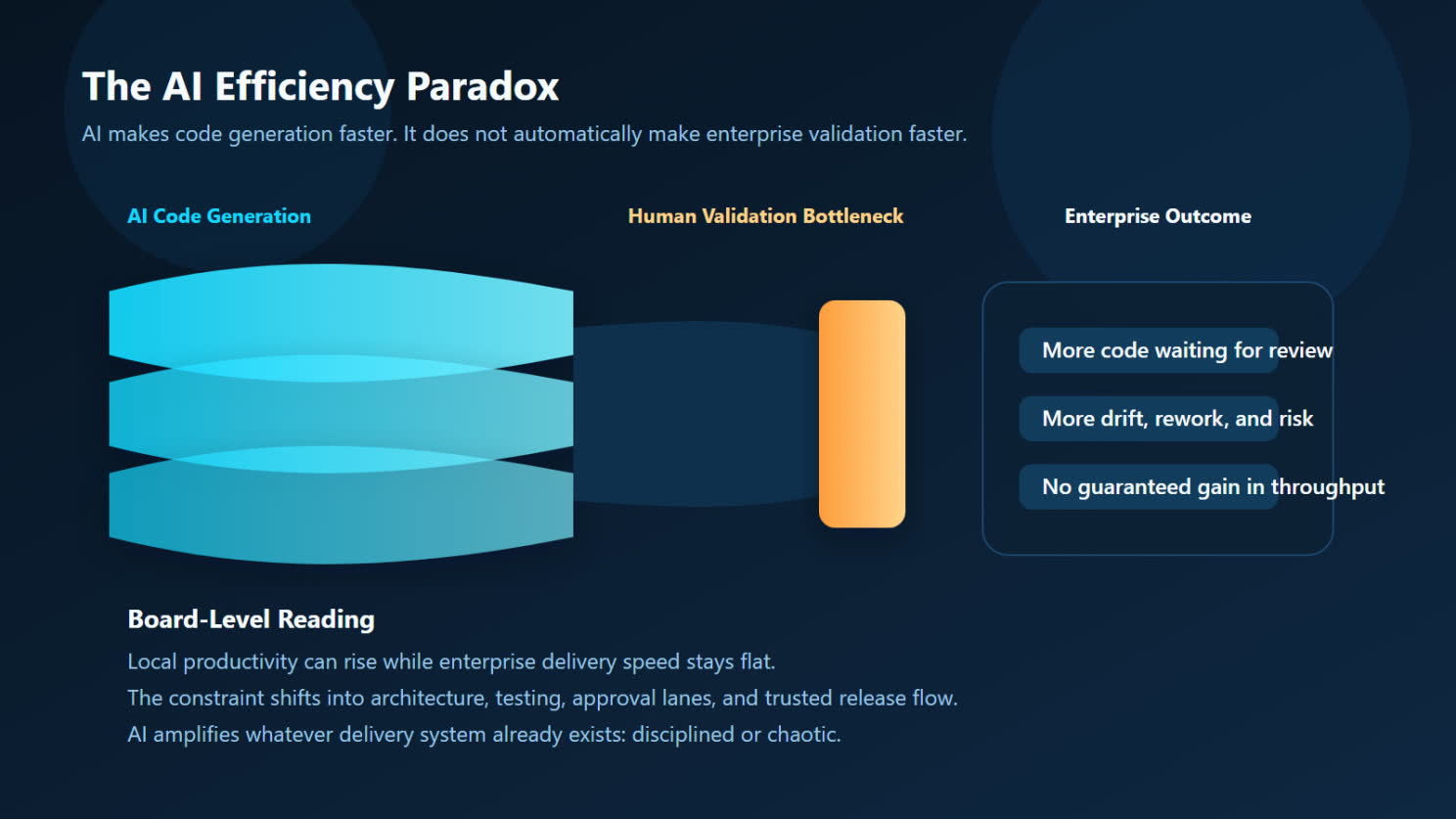
The Shift in Engineering Friction: Code generation accelerated while verification did not.
For years, many organizations treated software productivity as a question of output: more commits, more tickets closed, more lines shipped. That was always an incomplete view. The SPACE framework and later DevEx research pushed the conversation toward a more grounded understanding, one in which productivity is shaped by satisfaction, collaboration, feedback loops, cognitive load, and the ability to work in flow. Software performance, in other words, is sociotechnical rather than merely mechanical.
That distinction matters far more now. AI coding tools compress the act of authoring software, but they do not remove the need for engineering judgment. In many enterprises, they intensify it. The constraint simply moves downstream into review, testing, architecture, compliance, and change management. The system produces more code, but the organization does not automatically gain more trust, more clarity, or more control.
This is why so many AI initiatives create a misleading first impression. Teams experience an immediate boost in local speed, while the broader delivery system continues to run on human bottlenecks, fragmented tooling, and institutional memory. The result is an illusion of acceleration at the edge combined with drag at the center. From an executive perspective, that is the key insight: AI does not eliminate friction; it relocates it.
Why this becomes a business problem faster than most leaders expect
The financial logic is straightforward, even if the mechanics are technical. When engineers lose time to poor feedback loops, unclear ownership, weak documentation, brittle environments, and manual approvals, the cost does not remain trapped inside the engineering budget. It shows up everywhere that speed and reliability matter: product launches slow, security review becomes reactive, operational risk rises, and senior technical talent is pulled into low-leverage verification work instead of high-leverage design work.
The DevEx literature is now strong enough to make this argument in business terms. The 2023 ACM Queue article "DevEx: What Actually Drives Productivity" argues that improving developer experience drives efficiency, quality, and retention, and cites earlier McKinsey research showing that companies with better developer work environments achieved revenue growth four to five times greater than competitors. That is not a statement about morale in the abstract. It is a statement about enterprise performance.
The same research frames DevEx around three dimensions that are immediately legible to business leaders:
- Feedback loops
- Cognitive load
- Flow state
- Feedback loops
- Cognitive load
- Flow state
If feedback loops are slow, the enterprise pays in cycle time. If cognitive load is high, it pays in errors, dependency on experts, and onboarding drag. If flow is constantly interrupted, it pays in shallow work and slower problem-solving on the hardest issues. Once AI enters the picture, each of those costs can rise rather than fall unless the environment is redesigned intentionally.
The real boardroom question is not "Are we using AI?"
It is this: Do we have an operating model that can absorb AI-generated speed without losing control?
That is the bridge between technical depth and business value. Most executive teams do not need to know which model an engineering group uses or which editor a developer prefers. They do need visibility into whether the software delivery system can safely convert more generated output into more shipped value.
That requires a shift in how DevEx is understood. The old story positioned DevEx as an internal enablement topic centered on better developer tools, better onboarding, and better sentiment. The new story is operational and strategic:
- DevEx determines whether AI increases throughput or merely increases unfinished verification work.
- DevEx determines whether engineering scale comes from reusable systems or from heroic individuals.
- DevEx determines whether platform spend behaves like a compounding investment or an invisible tax.
- DevEx determines whether AI increases throughput or merely increases unfinished verification work.
- DevEx determines whether engineering scale comes from reusable systems or from heroic individuals.
- DevEx determines whether platform spend behaves like a compounding investment or an invisible tax.
That is why platform engineering is becoming central to the conversation. The CNCF Platform Engineering Maturity Model makes an important distinction here. At lower maturity, internal platform teams are treated as centralized cost centers reacting to technical requests. At higher maturity, the platform is run as a product, with explicit investment logic, feedback loops, product management, and measurable business value. That shift is not cosmetic; it determines whether the platform genuinely accelerates the business or simply reorganizes infrastructure work.
Team Topologies makes the same point from a different angle by arguing that the purpose of platform engineering is to accelerate the flow of value while reducing cognitive load at the right level of investment. That is language a CFO, COO, CIO, and CTO can align around.
What executives should measure instead of vanity speed
If AI is increasing code output, traditional activity metrics become even less useful. More pull requests do not prove more value. More generated code does not prove more progress. More tools do not prove a better system.
What matters is whether the organization is reducing friction in the places that determine business outcomes. For executives, the most useful DevEx questions tend to be these:
- How long does it take a change to move from idea to safe production?
- Where do our review and approval queues accumulate?
- Which engineering teams carry the highest cognitive load because the architecture, ownership, or documentation is unclear?
- How much senior engineering time is spent on repetitive validation rather than platform design, risk reduction, and architectural decisions?
- Do our internal platforms behave like products with adoption, feedback, and measurable ROI, or like ticket queues with better branding?
- How long does it take a change to move from idea to safe production?
- Where do our review and approval queues accumulate?
- Which engineering teams carry the highest cognitive load because the architecture, ownership, or documentation is unclear?
- How much senior engineering time is spent on repetitive validation rather than platform design, risk reduction, and architectural decisions?
- Do our internal platforms behave like products with adoption, feedback, and measurable ROI, or like ticket queues with better branding?
This is the level at which technology and business stop being separate conversations. A slow build pipeline is not only a developer annoyance; it is delayed learning. A manual release gate is not only process overhead; it is latent working capital tied up in unfinished change. A fragmented toolchain is not only technical complexity; it is management opacity, because no one can see clearly where time or risk is accumulating.
What good looks like in an AI-native engineering environment
An AI-enabled enterprise needs more than copilots. It needs a software delivery environment designed for both human judgment and machine speed, which means moving from informal norms to explicit operating constraints.
From the research and from modern AI-native engineering patterns, four characteristics stand out:
1. Governance becomes machine-readable
If quality, security, architecture, and regulatory expectations live only in tribal knowledge, AI will amplify inconsistency. The rules need to be legible to both humans and machines, and standards, architectural boundaries, approval criteria, and coding constraints need to be explicit enough to be enforced before low-quality work spreads.
2. Validation becomes modular and fast
The more centralized and monolithic the validation process, the more AI-generated throughput backs up behind it. High-performing environments break testing, policy checks, and diagnostics into smaller deterministic loops so that low-risk issues can be caught early and corrected quickly.
3. Risk routing becomes deliberate
Not every change deserves the same governance model. If a cosmetic front-end tweak and a sensitive identity or billing change both enter the same review lane, the organization creates unnecessary friction for the easy work and not enough scrutiny for the dangerous work. Mature environments route work by risk, not by habit.
4. Observability extends to the delivery system itself
If leaders cannot see where time is being lost, DevEx becomes anecdotal. The delivery system needs traces, measures, and feedback loops around the developer experience itself: build delays, test delays, waiting states, approval bottlenecks, and platform adoption patterns. These are not only engineering diagnostics; they are management instruments.
The executive mandate
Making code dramatically cheaper to generate does not make human judgment less valuable; it makes it more consequential.
That is the point many leadership teams will need to internalize over the next few years. In an AI-accelerated enterprise, the scarce resource is no longer raw code production. It is organizational comprehension, architectural judgment, and the ability to preserve trust, quality, and direction while the volume of possible change rises sharply.
That is why the executive question runs deeper than whether teams are using AI effectively. The real question is whether the institution itself is becoming more coherent as software velocity increases. If AI raises output while governance remains informal, the organization becomes faster at creating ambiguity. If output rises while platform design remains fragmented, it becomes faster at creating dependency. If output rises while review, security, and operational disciplines remain largely manual, it becomes faster at creating hidden risk.
This is where DevEx becomes a revealing leadership mirror. It exposes whether a company truly understands software as a strategic operating capability or whether it is still treating engineering as a local execution function. The difference is profound: one organization compounds learning, while the other compounds noise.
The executive mandate, then, is not to demand more code, more tools, or more activity. It is to build the conditions under which greater technical speed translates into better decisions, safer delivery, and clearer accountability. That means funding platforms as products rather than side infrastructure, reducing cognitive load deliberately because complexity is now a capital allocation issue rather than merely an engineering inconvenience, and replacing heroics with systems, informal memory with explicit pathways, and vanity productivity signals with measures that reflect trust, flow, and business throughput.
Above all, it means recognizing that the strategic advantage of AI is not automation in isolation. It is the combination of machine speed and institutional clarity. The companies that pull ahead will not be the ones that merely generate more software; they will be the ones that create an environment in which more software can be understood, governed, and translated into business value without losing control of the system.
That is why Developer Experience is no longer a functional concern inside engineering. It is a test of executive maturity.