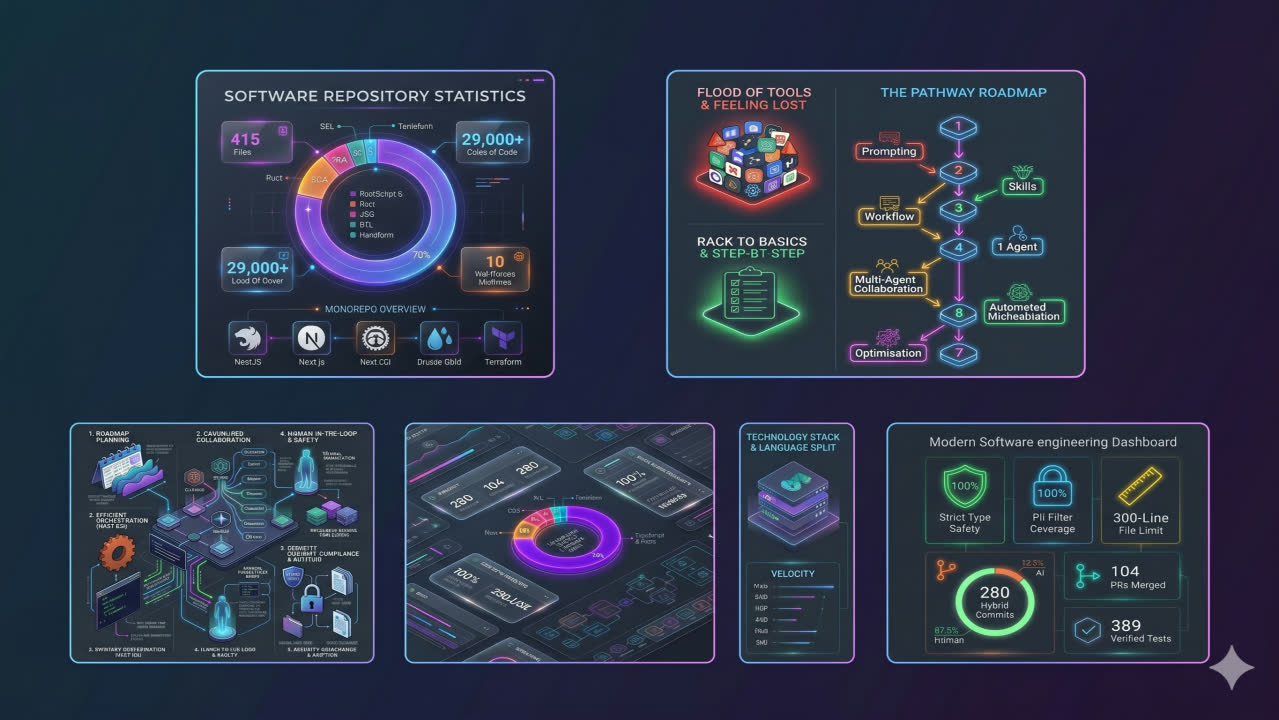
The Software Engineering Trap: Why Code is Cheap, but Decisions are Expensive 💡
The biggest trap in software engineering is thinking your primary value is writing code. It isn't. Writing code was always the easiest part, it is even more these days.
The biggest trap in software engineering is thinking your primary value is writing code. It isn't. Writing code was always the easiest part, it is even more these days.
This article is a reflection on my recent learning journey—going "all-in" on an AI-agentic development workflow to build a production-ready B2B SaaS. It is an exploration of what it means to build software when AI writes the syntax, and a breakdown of the key engineering concepts that remain completely non-negotiable for system design.
A friend came to me with a problem in his business. I proposed to help develop a software solution, under one condition: that I could use the process as a learning laboratory. I decided to go all-in: I wanted to build a production-grade platform using a purely agentic AI development workflow. I wanted AI agents to write the code, run the tests, write the docs, and manage the deployments.
Like many, I fell for the internet hype that building with AI was a trivial, five-minute affair. The reality check was brutal: my first week was a chaotic storm of conflicting code, infinite loops, and prompt fatigue. But the breakthrough came when I went back to basics—revisiting the AI concepts and focusing on mastering them one step at a time. Within two weeks, that structured focus unlocked a mind-blowing velocity where features were compiled, tested, and documented in minutes, leading me to a major realization: the more you automate, the more fundamental software engineering concepts actually matter.
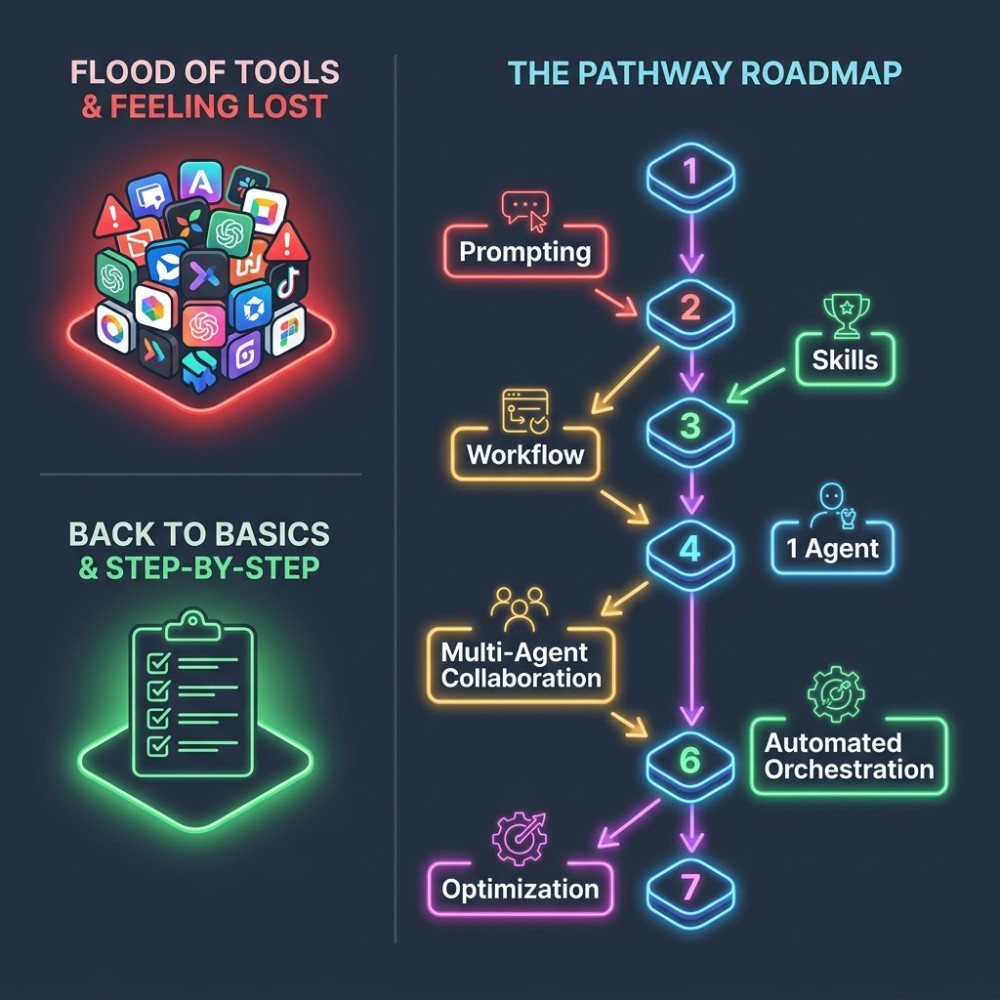
AI can write code, but it cannot design a system. Without clear architectural boundaries and solid engineering concepts, agentic development quickly devolves into high-speed chaos.
📦 The Context: Engineering a Modern B2B SaaS
To understand our architectural choices, we must first look at the engineering parameters of a modern, multi-tenant B2B platform (in private beta today!):
- The Core Objective: Shifting businesses from highly reactive selling workflows (handling requests ad-hoc) to automated, proactive workflows (leveraging predictive logistics, automatic scheduling, and intelligent routing).
- The Operational Environment: Catering to micro-entrepreneurs operating across international borders. From day-zero, the platform had to handle multi-lingual translations, timezone offsets, localized currencies, and strict data privacy regulations (such as GDPR).
- The Engineering Constraint: Bootstrapping a platform on a pre-revenue budget. This means the infrastructure must scale to zero when idle to prevent premature financial burn, while maintaining high security, performance, and continuous integration capabilities.
- The Methodology: A validation-first approach. We refuse to design backend features or provision cloud assets until their utility is proven against real-world user workflows, ensuring we never waste engineering resources building the wrong things.
- The Core Objective: Shifting businesses from highly reactive selling workflows (handling requests ad-hoc) to automated, proactive workflows (leveraging predictive logistics, automatic scheduling, and intelligent routing).
- The Operational Environment: Catering to micro-entrepreneurs operating across international borders. From day-zero, the platform had to handle multi-lingual translations, timezone offsets, localized currencies, and strict data privacy regulations (such as GDPR).
- The Engineering Constraint: Bootstrapping a platform on a pre-revenue budget. This means the infrastructure must scale to zero when idle to prevent premature financial burn, while maintaining high security, performance, and continuous integration capabilities.
- The Methodology: A validation-first approach. We refuse to design backend features or provision cloud assets until their utility is proven against real-world user workflows, ensuring we never waste engineering resources building the wrong things.
🤖 The Agentic SDLC: A Complete Team
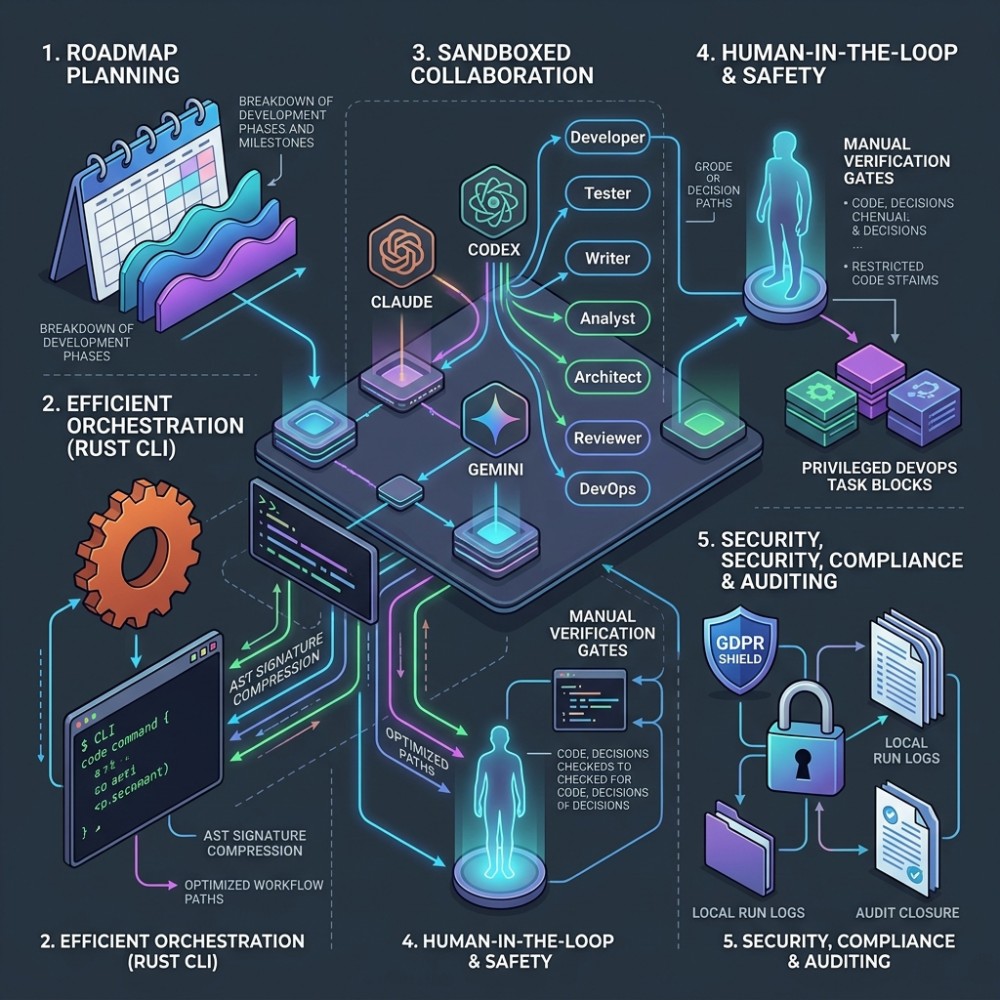
To achieve mind-blowing velocity without code degradation, we codified the Software Development Life Cycle (SDLC) into a structured Multi-Agent Team Architecture. Instead of using a single AI prompt, we split the workflow into specialized agent roles:
- The Orchestrator: Manages the overall workflow and coordinates the handoffs.
- The Analyst: Translates developer issues into testable Acceptance Criteria (AC).
- The Architect: Validates scope, reviews system impact, and writes Architectural Decision Records (ADRs).
- The Developer: Implements the feature strictly within the scope agreed by the Architect.
- The Tester: Validates the implementation against the Analyst's Acceptance Criteria.
- The DevOps Engineer: Manages CI/CD pipelines, container compilation, and Terraform infrastructure.
- The Tech Writer: Updates documentation surfaces before any code is marked ready for review.
- The Orchestrator: Manages the overall workflow and coordinates the handoffs.
- The Analyst: Translates developer issues into testable Acceptance Criteria (AC).
- The Architect: Validates scope, reviews system impact, and writes Architectural Decision Records (ADRs).
- The Developer: Implements the feature strictly within the scope agreed by the Architect.
- The Tester: Validates the implementation against the Analyst's Acceptance Criteria.
- The DevOps Engineer: Manages CI/CD pipelines, container compilation, and Terraform infrastructure.
- The Tech Writer: Updates documentation surfaces before any code is marked ready for review.
The 9-Phase Automation Proposal
Every single change follows a strict 9-phase gate system:
Why this works: The system operates with strict human-in-the-loop gates. If any phase fails or goes out of bounds, the orchestrator halts, preventing broken logic from propagating.
🚀 The Top 5 Architectural Concepts
1. Multi-Tenant Data Isolation Strategy (Defense in Depth) 🛡️
- The Concept: Decoupling security boundaries across multiple layers of the stack (application runtime logic + database storage engines) rather than relying on a single gatekeeper.
- Why it Matters: Application logic is written by humans (and AI) and is prone to errors—a single forgotten filter in a database query can leak tenant data. By enforcing Row-Level Security (RLS) at the database level alongside application-layer routing guards, you establish a failsafe. If one layer is bypassed or misconfigured, the other still blocks unauthorized access.
- The Concept: Decoupling security boundaries across multiple layers of the stack (application runtime logic + database storage engines) rather than relying on a single gatekeeper.
- Why it Matters: Application logic is written by humans (and AI) and is prone to errors—a single forgotten filter in a database query can leak tenant data. By enforcing Row-Level Security (RLS) at the database level alongside application-layer routing guards, you establish a failsafe. If one layer is bypassed or misconfigured, the other still blocks unauthorized access.
2. Unified Contract-Driven Development (Zero-Drift Boundaries) 🔗
- The Concept: Establishing a single, shared source of truth for data schemas that enforces validation at runtime and strict type compilation checks at build time across client-server boundaries.
- Why it Matters: Traditional systems suffer from "Type Drift"—where backend database updates and client-side expectations slowly diverge, leading to silent runtime crashes in production. By binding client and server communication to shared schemas (such as Zod and tRPC), type mismatches block compiling, forcing developers to resolve integration errors before they can deploy.
- The Concept: Establishing a single, shared source of truth for data schemas that enforces validation at runtime and strict type compilation checks at build time across client-server boundaries.
- Why it Matters: Traditional systems suffer from "Type Drift"—where backend database updates and client-side expectations slowly diverge, leading to silent runtime crashes in production. By binding client and server communication to shared schemas (such as Zod and tRPC), type mismatches block compiling, forcing developers to resolve integration errors before they can deploy.
3. AST-Driven AI Context Compression (Token-Budget Optimization) 🦀
- The Concept: Programmatically parsing source code into Abstract Syntax Trees (ASTs) to strip implementation details, leaving only system structures (types, schemas, and interfaces) for AI context ingestion.
- Why it Matters: Large codebases quickly overwhelm LLM context windows, driving up token costs, latency, and model hallucinations. By compressing files down to structural type declarations, we optimize the LLM's "token budget." This enables coding agents to reason about full-repo architecture faster, cheaper, and with higher accuracy.
- The Concept: Programmatically parsing source code into Abstract Syntax Trees (ASTs) to strip implementation details, leaving only system structures (types, schemas, and interfaces) for AI context ingestion.
- Why it Matters: Large codebases quickly overwhelm LLM context windows, driving up token costs, latency, and model hallucinations. By compressing files down to structural type declarations, we optimize the LLM's "token budget." This enables coding agents to reason about full-repo architecture faster, cheaper, and with higher accuracy.
4. Scale-to-Zero Service Architecture (Cost-Isolation) ☁️
- The Concept: Provisioning stateless serverless containers and serverless storage engines that automatically scale down to zero when idle, managed entirely via Infrastructure-as-Code (IaC).
- Why it Matters: In the pre-revenue validation phase, paying for idle CPU and database cycles is a waste of capital. A scale-to-zero serverless architecture ensures you only pay for active traffic, while IaC guarantees your entire infrastructure remains a version-controlled, reproducible blueprint.
- The Concept: Provisioning stateless serverless containers and serverless storage engines that automatically scale down to zero when idle, managed entirely via Infrastructure-as-Code (IaC).
- Why it Matters: In the pre-revenue validation phase, paying for idle CPU and database cycles is a waste of capital. A scale-to-zero serverless architecture ensures you only pay for active traffic, while IaC guarantees your entire infrastructure remains a version-controlled, reproducible blueprint.
5. Architecting for Non-Functional Requirements from Day-Zero 🌍
- The Concept: Structuring core capabilities like internationalization (i18n), timezone offsets, currency conversion, data privacy regulations (GDPR), and localization as core system constraints from the initial commit.
- Why it Matters: Developers often treat cross-cutting concerns like timezone differences, multi-lingual support, and region formatting as "features" to be added later. In reality, these are Non-Functional Requirements (NFRs) that must be baked into the database design, error logging, and API boundaries from day-zero. Trying to retrofit these rules onto a local-only platform later requires massive, high-risk database refactorings and total application rewrites.
- The Concept: Structuring core capabilities like internationalization (i18n), timezone offsets, currency conversion, data privacy regulations (GDPR), and localization as core system constraints from the initial commit.
- Why it Matters: Developers often treat cross-cutting concerns like timezone differences, multi-lingual support, and region formatting as "features" to be added later. In reality, these are Non-Functional Requirements (NFRs) that must be baked into the database design, error logging, and API boundaries from day-zero. Trying to retrofit these rules onto a local-only platform later requires massive, high-risk database refactorings and total application rewrites.
🧠 The 8 Underlying Engineering Concepts That Determined Our Success
I. Database Design & Zero-Downtime Migration Strategy
- Concept: Schema-as-Code & Migration Isolation
- Database schemas are treated as pure code. To support Zero-Downtime deployments, we follow a strict two-phase column lifecycle: Columns are deprecated in Release N, and only hard-dropped in Release N+1. This ensures that the active, running production application never encounters database schema mismatches during rollouts.
- Concept: Schema-as-Code & Migration Isolation
- Database schemas are treated as pure code. To support Zero-Downtime deployments, we follow a strict two-phase column lifecycle: Columns are deprecated in Release N, and only hard-dropped in Release N+1. This ensures that the active, running production application never encounters database schema mismatches during rollouts.
II. The Test Pyramid & Layered Verification
- Concept: Test Isolation & Merge-Gate Execution
- To maintain velocity without introducing regression bugs, we structured our testing suite into three distinct layers: Unit Tests: Fast, co-located tests executing on every file save. Integration Tests: Full module validations verified against active database environments. E2E Tests: Full-stack browser simulations run on merge to development, rather than on open PRs, saving valuable CI minutes and developer focus. All tied to the CI/CD workflow.
- Concept: Test Isolation & Merge-Gate Execution
- To maintain velocity without introducing regression bugs, we structured our testing suite into three distinct layers: Unit Tests: Fast, co-located tests executing on every file save. Integration Tests: Full module validations verified against active database environments. E2E Tests: Full-stack browser simulations run on merge to development, rather than on open PRs, saving valuable CI minutes and developer focus. All tied to the CI/CD workflow.
III. Spec-Driven Development & AI-Orchestrated SDLC
- Concept: High-Fidelity Requirements & Alignment Gates
- Before writing code, we construct a specification file directly from our requirements. Development is blocked if the specification contains unresolved questions. Once aligned, a structured 9-phase orchestration workflow runs, utilizing specialized AI roles (Analyst, Architect, Developer, Tester, DevOps, Tech Writer) to guide features through rigorous quality and security reviews.
- Concept: High-Fidelity Requirements & Alignment Gates
- Before writing code, we construct a specification file directly from our requirements. Development is blocked if the specification contains unresolved questions. Once aligned, a structured 9-phase orchestration workflow runs, utilizing specialized AI roles (Analyst, Architect, Developer, Tester, DevOps, Tech Writer) to guide features through rigorous quality and security reviews.
IV. Pragmatic Service Architecture: Monorepo vs. Microservices
- Concept: Modularity Over Premature Distribution
- We resisted the urge to build microservices too early. Instead, we established a Modular Monorepo. Code boundaries are physically separated into distinct packages (database schemas, TypeScript types, configuration, frontend UI), but the application compiles and deploys as a cohesive monolith. This gives us the boundary benefits of microservices without the operational network overhead.
- Concept: Modularity Over Premature Distribution
- We resisted the urge to build microservices too early. Instead, we established a Modular Monorepo. Code boundaries are physically separated into distinct packages (database schemas, TypeScript types, configuration, frontend UI), but the application compiles and deploys as a cohesive monolith. This gives us the boundary benefits of microservices without the operational network overhead.
V. Strict Language & Framework Usage
- Concept: Type Strictness & Dependency Injection
- By locking down type compiler flags to force explicit undefined checks on array accesses and using modular dependency injection structures, we ensure that the codebase is highly modular, easily testable, and resistant to spaghetti dependencies.
- Concept: Type Strictness & Dependency Injection
- By locking down type compiler flags to force explicit undefined checks on array accesses and using modular dependency injection structures, we ensure that the codebase is highly modular, easily testable, and resistant to spaghetti dependencies.
VI. Value-First Cost Analysis
- Concept: ROI-Driven Tool Selection
- Every third-party service was selected based on developer efficiency and operational overhead: we chose tools with generous developer free tiers (such as open-street-maps geocoders and serverless storage tiers) to ensure development environments cost nothing to run.
- Concept: ROI-Driven Tool Selection
- Every third-party service was selected based on developer efficiency and operational overhead: we chose tools with generous developer free tiers (such as open-street-maps geocoders and serverless storage tiers) to ensure development environments cost nothing to run.
VII. Boundary Contract Standardization (Defensive Serialization)
- Concept: Eliminating structural ambiguities at external integration interfaces.
- When geographic, temporal, or numerical data crosses boundaries between third-party APIs, frontend components, and databases, minor format discrepancies (such as latitude/longitude coordinate swaps or float precision issues) cause silent data corruption. Enforcing strict, standardized serialization protocols (such as GeoJSON and standard SRID 4326 formats) at all boundary contracts mitigates these bugs before they propagate into storage.
- Concept: Eliminating structural ambiguities at external integration interfaces.
- When geographic, temporal, or numerical data crosses boundaries between third-party APIs, frontend components, and databases, minor format discrepancies (such as latitude/longitude coordinate swaps or float precision issues) cause silent data corruption. Enforcing strict, standardized serialization protocols (such as GeoJSON and standard SRID 4326 formats) at all boundary contracts mitigates these bugs before they propagate into storage.
VIII. Validation-First Product Roadmap
- Concept: User-Feedback Loop & Business Validation
- We refuse to build features in a vacuum. The product roadmap is driven directly by the operational needs of a real-world local business. Every feature on our roadmap is validated against this real business context before engineering resources are allocated, ensuring we construct software that solves real business problems.
- Concept: User-Feedback Loop & Business Validation
- We refuse to build features in a vacuum. The product roadmap is driven directly by the operational needs of a real-world local business. Every feature on our roadmap is validated against this real business context before engineering resources are allocated, ensuring we construct software that solves real business problems.
🛑 The New Bottleneck: Optimization Requires Understanding!
When you achieve mind-blowing agentic coding velocity, you quickly hit a new, unexpected bottleneck: Your limit is no longer how fast you can write code, but how deeply you understand your codebase and are able to steer it.
AI coding agents can generate thousands of lines of syntax in seconds. But they cannot evaluate whether that syntax is structurally sound, secure, or cost-optimal.
- If you do not understand Database Indexing, you will not realize that the AI forgot to generate a GIST index for your spatial queries.
- If you do not understand Zero-Downtime Deployments, you will approve a database migration that locks tables and causes production downtime.
- If you do not understand TypeScript AST structure, you will not know how to build the CLI tools that compress the AI's own context windows.
- If you do not understand Database Indexing, you will not realize that the AI forgot to generate a GIST index for your spatial queries.
- If you do not understand Zero-Downtime Deployments, you will approve a database migration that locks tables and causes production downtime.
- If you do not understand TypeScript AST structure, you will not know how to build the CLI tools that compress the AI's own context windows.
In an agentic developer world, the engineer's role shifts from writer to editor and director. You cannot review what you do not understand. If you lack a strong grasp of fundamental computer science concepts, your AI agents will build a house of cards that collapses at the first sign of scale.
⚡ The Veredict
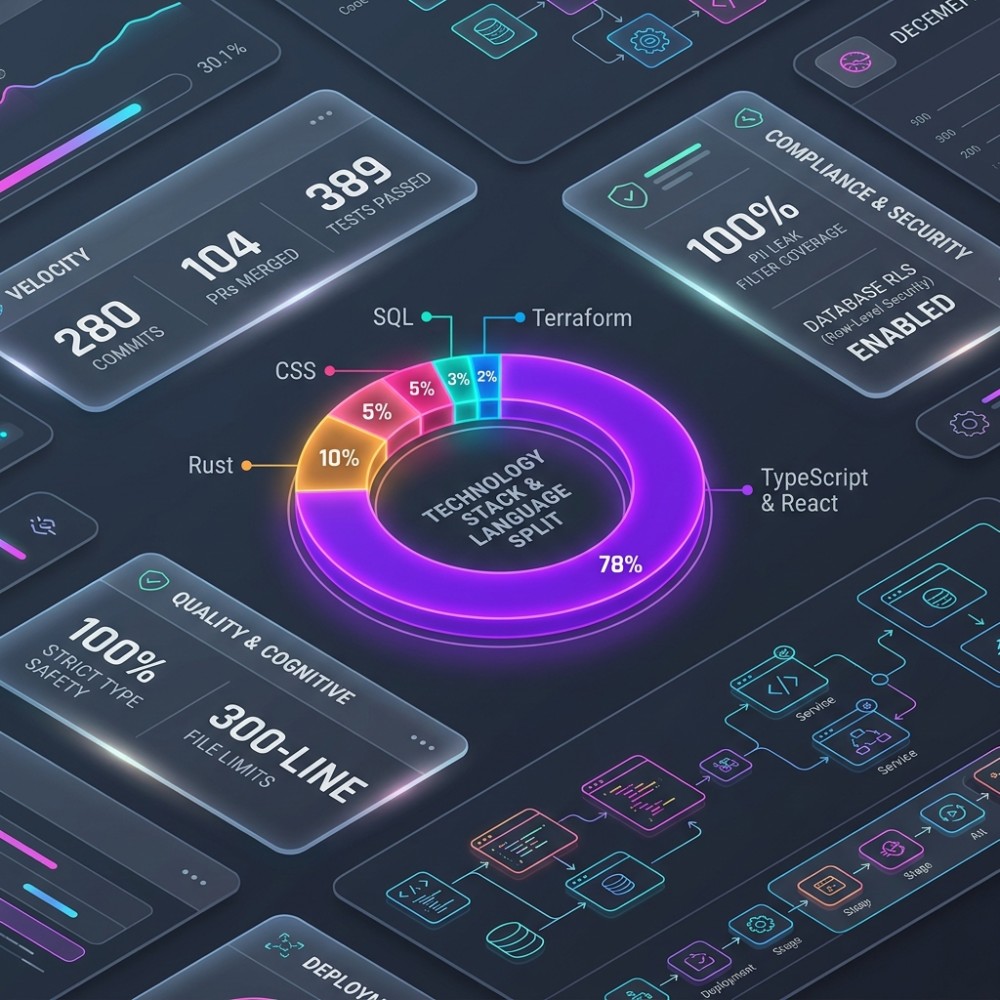
Building software is not about typing code as fast as you can (you don't even type anymore). It's about setting up the structural constraints that keep the codebase secure, performant, and maintainable over time.
What is one architectural "constraint" or decision you've made in your codebase that paid off in the long run? Let's discuss in the comments! 👇
#SoftwareEngineering #AI #AgenticWorkflows #SystemDesign #SaaSArchitecture