Legacy Modernization Is a Solved Problem. So Why Do Most Initiatives Still Fail?
Patterns, failure modes, and the strategic decisions that determine the outcome — before a line of code changes.
Patterns, failure modes, and the strategic decisions that determine the outcome — before a line of code changes.
Every organisation I know is running two bets in parallel right now. One is an AI strategy with new models, new use cases, new promises to the board. The other is a legacy modernization initiative midst ageing systems, mounting technical debt, and a growing list of things that can't happen until the old infrastructure is replaced.
Most are treating them as separate problems. The dependency, though, runs in one direction: your AI strategy is only as good as the foundation it runs on. And for most enterprises, that foundation is not ready.
What follows is less about the technology and more about the decisions to define which patterns to use, when, and what tends to go wrong when those choices are made without enough information.
Start with the failure rate
79% of application modernization projects fail after organizations have already invested more than $1.5 million.
Anyone who has run one of these initiatives has felt the weight of that number. What it implies is worth sitting with: the problem is rarely a lack of investment or intention. It tends to be a lack of judgment about which patterns apply to which context, and when.
The organisations that succeed are generally not using better tools. They are making better decisions earlier.
Patterns exist — but they are not a menu
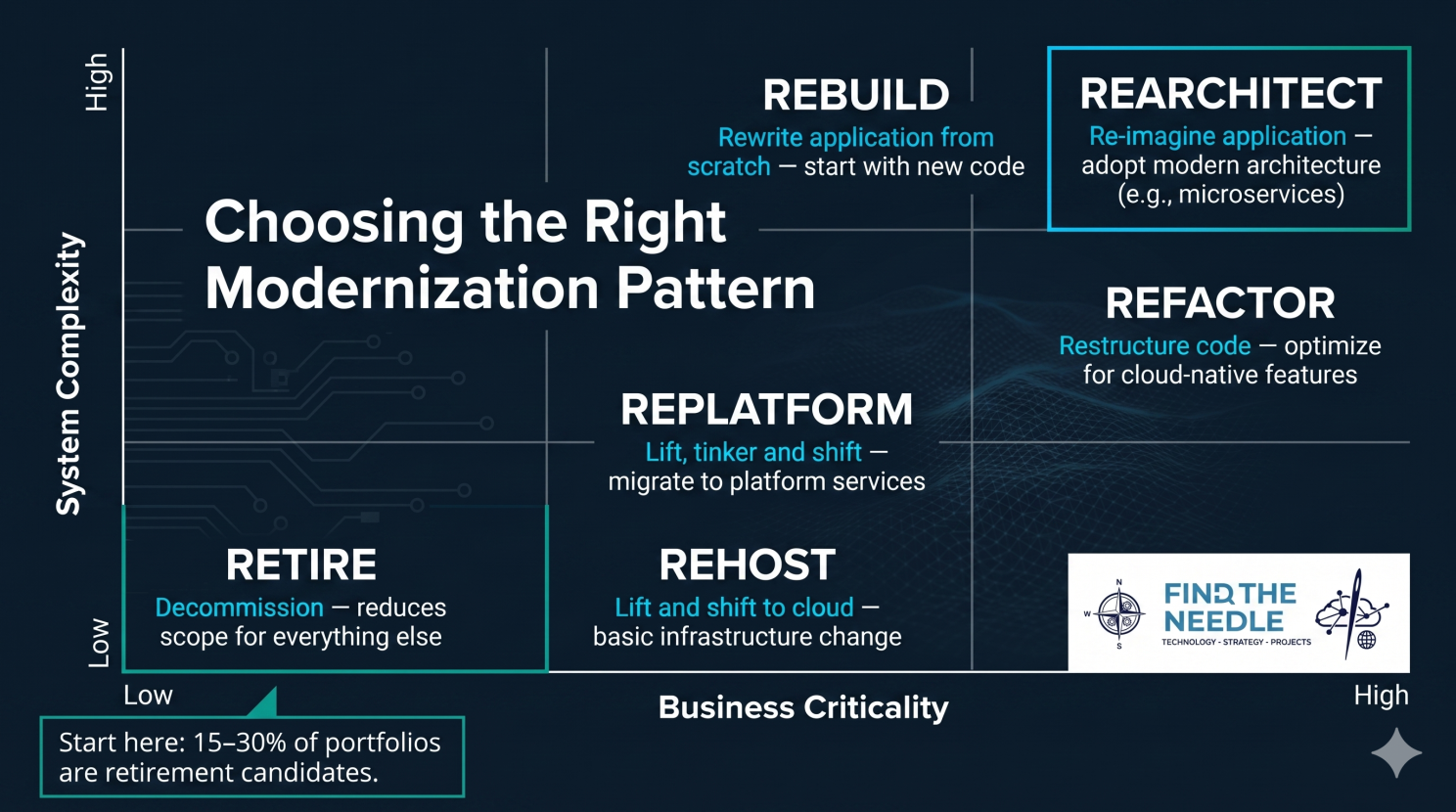
Legacy modernization has a well-documented set of strategic patterns. The 6 Rs are the most commonly cited framework: Rehost, Replatform, Refactor, Rearchitect, Rebuild, Retire. Every major consultancy has a version of this map.
The mistake is treating these as a menu. They are not. They are a decision tree and the branch you take depends entirely on the operational context of the system in front of you.
The Strangler Fig pattern, for example, is widely recommended and genuinely powerful: wrap the legacy system in an API layer, expose its data and functions to modern applications, then gradually replace the old system from the outside in. No big-bang cutover. Continuous delivery. Lower risk.
But it only works if the system has relatively stable interfaces and the team can afford the parallel running cost. Apply it to a system with undocumented integrations that have never been inventoried, and you will not reduce risk, you will hide it behind an abstraction layer until it surfaces at the worst possible moment.
The same logic applies to Change Data Capture, Anti-Corruption Layers, Shadow Execution. Each is a legitimate tool. Each has a context where it creates value and a context where it creates false confidence.
Engineering judgment is what maps tool to context, the discipline to choose deliberately given what the system in front of you actually is.
Recurring failure modes
Most modernization failures are not random. They cluster around a small set of recurring patterns. Recognising them early is usually the difference between a recovery and a initiative that gets quietly cancelled.
The Big Bang Migration Trap is the most expensive. An organisation commits to a full system replacement on a fixed timeline, underestimates the hidden integrations and capabilities that go unnoticed until you move the system and ends up managing a production crisis mid-migration. The mitigation is not to avoid ambition. It is to retire first, rearchitect last, and sequence risk in discrete increments.
The Distributed Monolith is the most insidious. You decompose a monolith into services, declare victory, and then discover that the services are still tightly coupled failing together. You have the operational complexity of microservices with none of the independence. The architecture looks modern. The behaviour is the same.
The Dirty Data Hangover is the one most teams discover too late. Legacy databases encode business logic through magic values, flags, and denormalised shortcuts that accumulated over years. Moving the data without understanding what those patterns mean will break the systems that depend on them, in ways that are difficult to detect and expensive to roll back.
Premature Programme Termination is the governance failure. Modernization initiatives are funded as projects, run out of runway before the value is visible, and get cancelled mid-transition, leaving the organisation with dual-running costs and no clear ownership of either system.
None of these are inevitable. But they tend to be invisible until they are expensive.
Data migration deserves its own initiative
Data migration is one of the most consistently underestimated parts of modernization work. It tends to get absorbed into the broader initiative as a technical task, when it really needs to be managed as a product in its own right — with its own acceptance criteria, validation gates, and definition of done.
The consequence is predictable. The automated migration pipeline executes cleanly. The data arrives in the target environment. And weeks later, someone discovers that the schema omissions carried over legacy defects, or that the transformation logic introduced drift that didn't show up until the system was under production load.
A rigorous migration treats each stage as a gate: discovery, translation, extraction, transformation, load and ingestion, validation, then cutover. The validation stage — data parity via dual-read metrics — is not optional. Teams that skip it tend to discover why during production load, not before.
What AI changes — and what it doesn't
AI is now a genuine accelerator in modernization work. The Bun runtime rewrite I wrote about yesterday — 960,000 lines of code converted between languages in six days — is not an outlier. At enterprise scale, AI agents are extracting business rules from undocumented COBOL, generating characterization tests from production behaviour, and accelerating code analysis that previously took weeks.
McKinsey estimates AI can accelerate modernization timelines by 40 to 50 percent when applied well, and the case studies support that range.
What AI does not change is the strategic layer. It cannot tell you which of the 6 Rs applies to a given system, or whether a team has the cognitive bandwidth to manage a parallel-running Strangler Fig alongside live production. It cannot recover the organisational memory embedded in code that looks like a bug but is actually load-bearing behaviour.
The thinking that has to happen before execution starts is still a human job. AI makes the execution faster — and that raises the cost of getting the strategy wrong, not lower.
Three questions before committing to a path
Before locking in a modernization approach, three questions tend to clarify the decision significantly:
Does this system block AI adoption? If the answer is yes, it is no longer a maintenance backlog item. It is a strategic constraint and it should be treated as one, with the urgency and executive sponsorship that implies.
What is the true cost of non-action? Legacy maintenance costs rise 15 to 25 percent annually. Security and compliance exposure compounds. The organisations that treat modernization as something to start next year are not preserving optionality, they are narrowing it.
Can we sequence the risk? The most successful initiatives retire dead weight first, stabilize the core next, and rearchitect the complex systems last. Incremental, domain-scoped modernization reduces risk and creates early wins that sustain momentum for the harder work that follows.
The dependency that connects everything
Modern AI workloads need real-time data access, clean API surfaces, and continuous model training pipelines. Most legacy systems cannot provide any of those. Funding an AI strategy and a legacy modernization initiative as parallel, independent workstreams — without acknowledging that one is a prerequisite for the other — tends to be the most expensive misalignment in enterprise technology planning.
The patterns are documented. The failure modes are well understood. What separates the initiatives that succeed is not access to a secret playbook — it is the discipline to apply known judgment to the specific system, team, and context in front of you.
#LegacyModernization #SystemsThinking #EngineeringLeadership #EnterpriseArchitecture #AIStrategy