
On Technology Trends and Hype: A Guide for Strategic Planning
"Smart companies fail because they do everything right. They cater to high-profit-margin customers and ignore the low end of the market, where disruptive innovations emerge from." The Innovator's Dilemma (Clayton Christensen)
"Smart companies fail because they do everything right. They cater to high-profit-margin customers and ignore the low end of the market, where disruptive innovations emerge from." The Innovator's Dilemma (Clayton Christensen)
Strategy is about making choices. More specifically, it's about making expensive, long-term choices that are hard to reverse. These choices are expensive not just in money, but in time, in people, and in opportunity cost—betting on one path means deciding not to take others. When technology is involved, this process becomes even more difficult because the path forward is rarely clear.
New technologies, trends, and buzzwords appear constantly. Deciding which ones matter—and which ones are just noise—is one of the hardest parts of leadership. It’s a modern version of what Clayton Christensen called the "Innovator's Dilemma," where doing everything "right" according to your current business can still lead to failure if you miss the next, less-obvious shift. As Christensen noted, "The reason why it is so difficult for existing firms to capitalize on disruptive innovations is that their processes and their business model... make them good at the existing business, and they are not good at the new."
In short, the very things that make a company successful today can blind it to the forces that will define tomorrow. So, how do we navigate this fog? Many of us turn to analyst reports for a map, hoping they will show us a clear path.
The Allure of the Map
When we feel lost, we look for clarity. For many executives, the most famous "map" for technology is the Gartner Hype Cycle. It’s a compelling narrative that gives us a sense of control.
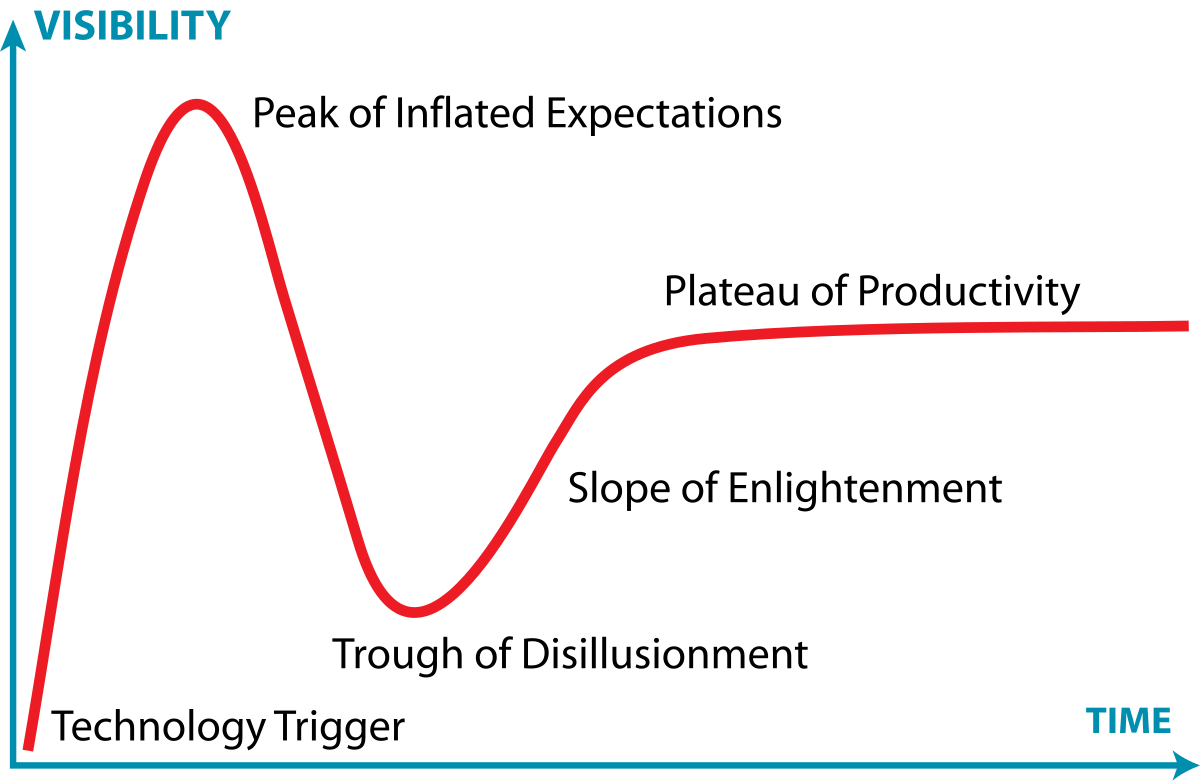
It’s a five-stage story that feels intuitive:
- Innovation Trigger: A new idea appears. It's a breakthrough, a proof-of-concept, and media interest begins.
- Peak of Inflated Expectations: A wave of excitement and media hype builds, driven by success stories (and ignoring the failures). This is the point of maximum noise.
- Trough of Disillusionment: The excitement fades as the technology fails to meet the sky-high expectations. Implementations fail, and the conversation sours.
- Slope of Enlightenment: Practical, real-world benefits start to emerge as the technology improves and its application is better understood.
- Plateau of Productivity: The technology becomes a mainstream tool, its value is stable, and it's part of how we work.
- Innovation Trigger: A new idea appears. It's a breakthrough, a proof-of-concept, and media interest begins.
- Peak of Inflated Expectations: A wave of excitement and media hype builds, driven by success stories (and ignoring the failures). This is the point of maximum noise.
- Trough of Disillusionment: The excitement fades as the technology fails to meet the sky-high expectations. Implementations fail, and the conversation sours.
- Slope of Enlightenment: Practical, real-world benefits start to emerge as the technology improves and its application is better understood.
- Plateau of Productivity: The technology becomes a mainstream tool, its value is stable, and it's part of how we work.
The appeal of this model is its predictability. It suggests that the path, while bumpy, is known. But it's important to understand what this model is tracking. It’s less a map of the technology’s development and more a map of human psychology—our innate attraction to novelty, our tendency for social contagion (the "fear of missing out" that ripples through boardrooms), and our collective relief when a clear-headed, "pragmatic" path finally emerges.
The model is simple and visually compelling. But is it accurate?
What the Data Says
When we look at the historical data, we find that this "map" is not always a reliable guide. The story we tell about innovation is often simpler than the reality. Believing the story without question is a strategic risk.
Here are a few important facts to consider:
- The "Cycle" is a Rarity: One 2024 analysis found that only about 20% of technologies actually follow the full five-stage path. This means that if you're building a strategy that assumes a technology will follow this "standard" trajectory, you are making a low-probability bet.
- The "Trough" is Often a Graveyard: The model's upward "Slope" implies that technologies recover from the Trough. In reality, an estimated 60% of innovations that fall into disillusionment never recover. They simply fade away. This means that "waiting out the trough" is not a safe strategy; it's a bet that a technology will be in the minority that survives.
- The Map Misses the Real Landmarks: Perhaps half of all successful, foundational innovations are "silent achievers." Technologies like cloud computing or open-source software became industry standards without ever riding the dramatic rollercoaster of hype. The Hype Cycle is designed to track hype, so it naturally misses the high-utility, low-hype innovations that can quietly remake an industry.
- The "Cycle" is a Rarity: One 2024 analysis found that only about 20% of technologies actually follow the full five-stage path. This means that if you're building a strategy that assumes a technology will follow this "standard" trajectory, you are making a low-probability bet.
- The "Trough" is Often a Graveyard: The model's upward "Slope" implies that technologies recover from the Trough. In reality, an estimated 60% of innovations that fall into disillusionment never recover. They simply fade away. This means that "waiting out the trough" is not a safe strategy; it's a bet that a technology will be in the minority that survives.
- The Map Misses the Real Landmarks: Perhaps half of all successful, foundational innovations are "silent achievers." Technologies like cloud computing or open-source software became industry standards without ever riding the dramatic rollercoaster of hype. The Hype Cycle is designed to track hype, so it naturally misses the high-utility, low-hype innovations that can quietly remake an industry.
The recent, rapid development of AI has further exposed the model's limits. Instead of a peak and a trough, AI is showing a "perpetual peak," where new breakthroughs (like GPT-4, or Sora for video) arrive before we can even get disillusioned with the last one. This breaks the model's timeline. There is no time for a "trough," which compresses investment cycles and makes the risk of not participating feel dangerously high.
So, if the map is often wrong, how should we use it?
How to Use Trend Reports (Without Being Fooled)
A trend report should be an input for your thinking, not the output of your strategy. The main problem is not the report itself, but how we use it. We confuse a simple model with complex reality.
Pitfall 1: The "Shiny Object" Trap. We start with the report, see a technology at the "Peak," and ask, "What is our strategy for X?" This is backward. It leads to what some call "AI Theatre"—launching splashy, high-profile projects that look good in a press release but deliver no real business value. This kind of work drains resources and creates cynicism when the "AI-powered" solution turns out to be a simple script.
- How to avoid it: Start with your internal business problems, not the external hype. Don't ask, "What is our AI strategy?" Ask, "We need to reduce customer service costs by 30% while improving satisfaction. What is the best tool to do that?" The answer might be AI, or it might be a simpler process change, or better training for your staff.
Pitfall 2: Believing the "Map" is the "Territory." We trust the model as a predictive tool, investing heavily at the "Slope" or pulling out at the "Trough." This treats a simplified psychological narrative as an investment guide. The map is a static drawing; the territory is the complex, dynamic, real world.
- How to avoid it: Use the reports to understand the market conversation, not to predict the future. Then, triangulate your sources. Read what Gartner, Forrester, and Deloitte are saying. But then go talk to your customers—do they even care about the problem this tech solves? Talk to your engineers—what are the real-world integration challenges and capabilities, beyond the marketing claims? Focus on your organization's internal readiness—your talent, your data, and your culture—which is far more important than the technology's place on a curve.
As Peter Drucker said, "Strategy is a commodity, execution is an art." These reports can't tell you how to execute. The real work is figuring out the "how" inside your own unique organization.
Next Steps
Technology trend reports are like weather forecasts. They are interesting, they are based on data, and they are a useful part of your planning. But you don't build a house based on a 10-day forecast. You build it with a strong foundation to withstand any weather. That foundation is your internal capability, your clear-headed problem-solving, and your team's culture.
In my next article, we'll move from why we get this wrong to how we get it right. I'll cover more practical ways to think about building an adaptable technology strategy—one that is prepared for multiple futures, not one that bets on a single prediction.